
Multi-site mutagenesis
Name the substitutions you want anywhere in a gene and get the mutagenic oligos for them, designed for the one-tube multi-site protocol.
| Reached by | Tools → Cloning |
| Sample project | Site-directed mutagenesis |
What it does
You name the substitutions you want anywhere in a gene — T66F, G68D, K108R — and it designs
the mutagenic oligonucleotides that introduce all of them in one reaction, then tells you the
single annealing temperature at which that reaction works.
The interesting part is not designing an oligo for a substitution; any primer tool does that. It is deciding how many oligos you need. Two substitutions six base pairs apart belong on one oligonucleotide; two that are two hundred base pairs apart cannot share one at any length. The solver works that out for you, merging neighbouring sites onto a shared oligo wherever the geometry allows and splitting them where it does not, while holding every oligo it emits inside one common melting-temperature window so they can all go in the same tube.
Where a position asks for more than one destination amino acid, it collapses the request into a single degenerate codon that encodes exactly those residues, so one oligo carries the whole small library rather than one oligo per variant.
When you'd use this
You have a hypothesis that involves several residues at once: an active site you want to swap wholesale, a set of surface residues you are re-charging, a published variant you are reconstructing from a paper that lists four substitutions. Making those one at a time means four rounds of mutagenesis, four transformations and four sequencing reactions.
Reach for this when:
- you want two or more substitutions in the same construct, and you would rather do one reaction than a chain of them;
- the substitutions are scattered, so you cannot simply cover them with one long primer by eye;
- some positions have more than one candidate residue and you want the small library rather than a committed single variant.
Reach for something else when the change is a single substitution (use Site-Directed Mutagenesis's Mutate tab, which gives you ranked primer pairs for one edit), when you want every amino acid at a few named positions (that is Site-saturation mutagenesis), or when the edit is an insertion or deletion rather than a substitution (the Indel tab, which designs back-to-back Q5/KLD primers instead).
What this computes
The design problem here is joint, not per-site: every oligo has to work under one thermal programme, so this picks the best set rather than the best primer for each site.
- An oligonucleotide set, each with its sequence, length, position and thermodynamics
- The single reaction temperature the whole set is designed to run at
- The amino-acid coverage the design achieves — which is where a wild-type letter that does not match the template shows up as a low number rather than as silence
- The codons chosen, and the random seed that produced them, so a design you ordered can be reproduced
- Several targets at one position (
K3L K3W) read as a request for both, and collapsible into one degenerate codon covering them - Whether coverage below 100% is the answer — when no codon set reaches every requested amino acid inside the windows, the best cover found is returned rather than nothing, and the reading says which lever moves it: widening the GC band or the size range, not redrawing with another seed
- Which constraints any returned primer breaks, named individually (melting temperature, arm sizes, GC content, hairpin or homodimer), because the solver returns its best solution rather than refusing, so a breach ships unless you act on it
- That the codon cover is drawn rather than derived, with the seed that reproduces it — the same request and a different seed give different oligos
Melting temperatures come from the same nearest-neighbour and hairpin/dimer calculations the rest of the workbench uses, so a Tm quoted here means the same thing as one quoted in the primer designer, and the designs are checked against the published multi-site designer this method comes from, case for case.
Where it lives
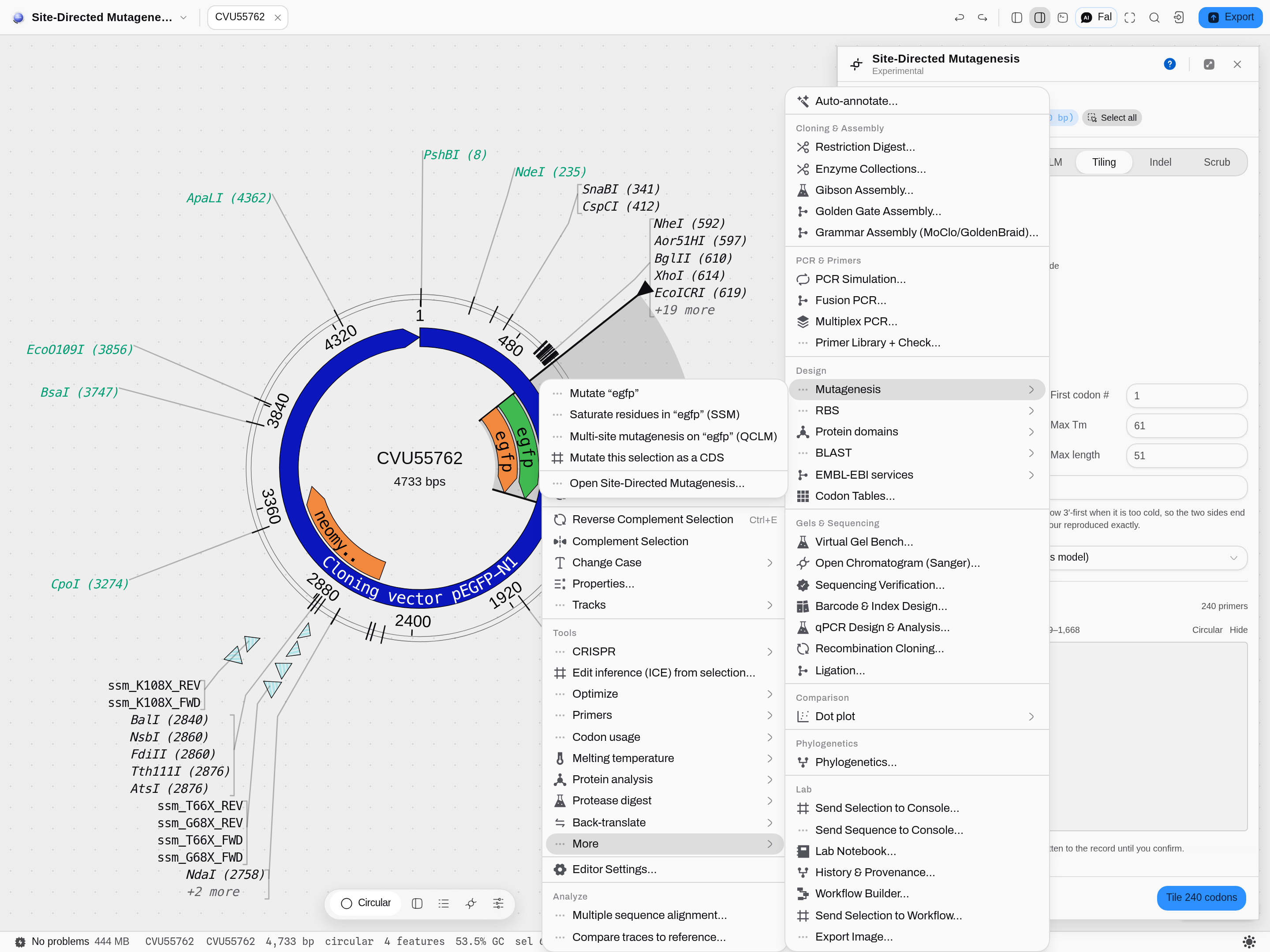
QCLM is a tab of the Site-Directed Mutagenesis panel, and it is also reachable scoped to what you clicked: right-click a coding sequence on the map and take Multi-site mutagenesis on "", and the panel opens already pointed at that gene rather than at a blank picker. The command palette carries the same verb.
Its output reaches the canvas: Add oligos to the map draws every designed oligonucleotide as a primer feature at its real coordinate, on the circular, linear and sequence views alike, so you can see where each one lands relative to the gene before you order anything.
Inputs and outputs
In: a coding sequence — a CDS feature on the open record, or a selection you nominate as a
coding sequence — plus a list of substitutions written as <wild-type><position><target>, one per
line or space-separated. Several targets at one position (K3L K3W) are read as a request for both.
Out: the oligonucleotide set, each with its sequence, length, position and thermodynamics; the single reaction temperature; the amino-acid coverage the design achieves; the codons chosen; and the random seed that produced them. Everything exports, and the oligos can be written to the record as primer features.
What it refuses, and how it tells you. A coding sequence whose length is not a multiple of three
is rejected up front, because its codons cannot be addressed at all. A substitution whose wild-type
letter does not match the sequence at that position is refused, listing exactly which sites
disagree, what the sequence actually has there, and where the letter you typed really occurs. It
almost always means you are working in a different numbering convention from the record in front of
you. A malformed site (145, with no amino-acid letters) is
refused with the form it wanted. Nothing fails by producing an empty table.
Worked example
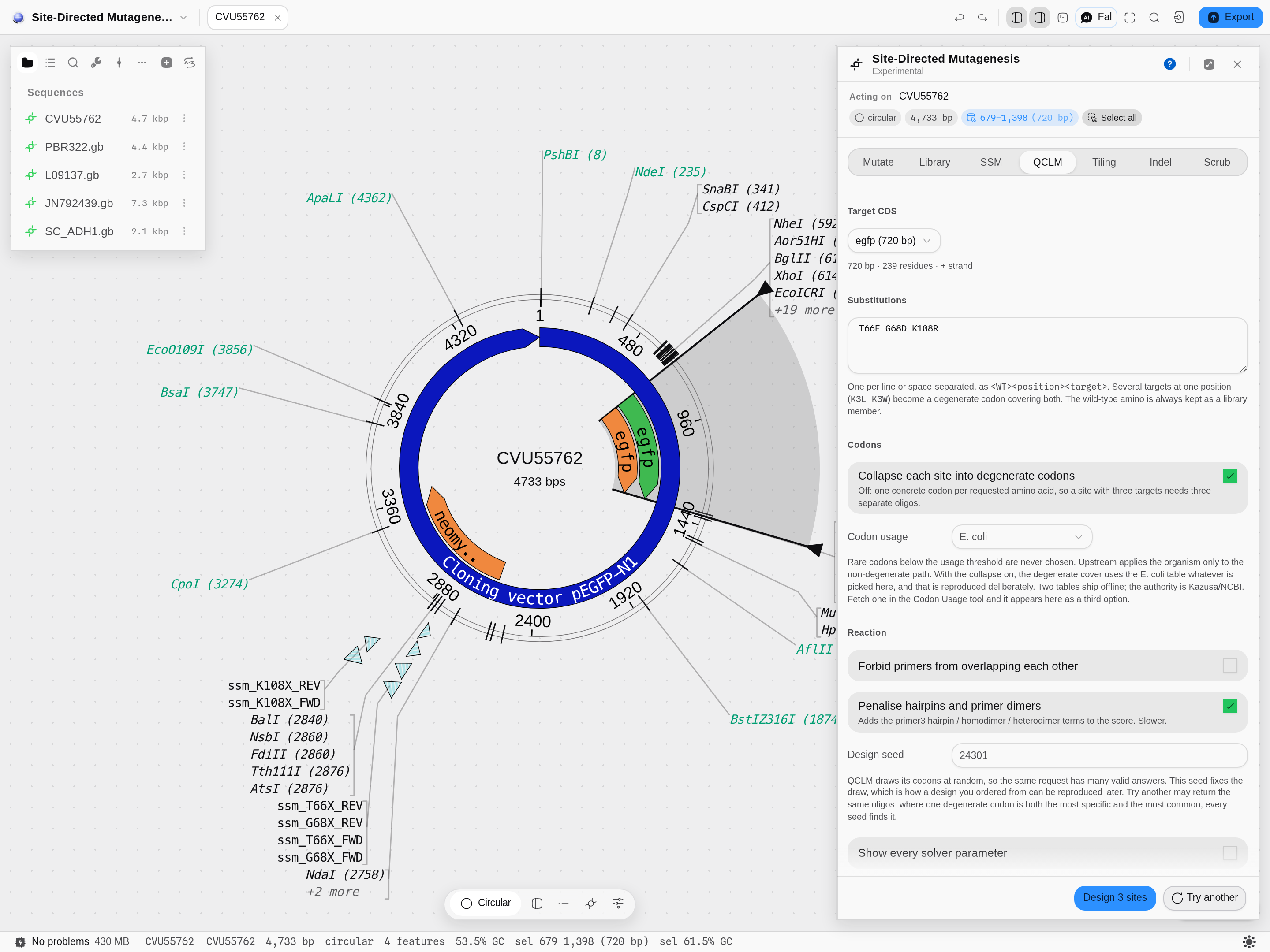
Open the Site-directed mutagenesis sample project and stay on CVU55762, the pEGFP-N1 cloning
vector, whose egfp coding sequence is 720 bp / 239 residues.
- Open Tools → Site-Directed Mutagenesis and pick the Multi-site tab.
- Set Target CDS to
egfp (720 bp). The line beneath confirms `720 bp · 239 residues ·- strand`.
- In Substitutions, enter
T66F G68D K108R. The button beneath reads Design 3 sites. - Press it. The result is 3 oligos for 3 substitutions, one reaction temperature of 75.5 °C, 100% amino-acid coverage, and the design seed 24301 that produced them.
- Read the codons chosen row. Positions 66 and 68 are six base pairs apart, so the solver put them on one oligonucleotide; position 108 gets its own. That merge is the whole point of the tab, and it is the thing you cannot get by designing three primers separately.
- Press Add oligos to the map. Each oligo appears on the plasmid at its real coordinate, and the panel's span readout agrees with the editor's own status bar.
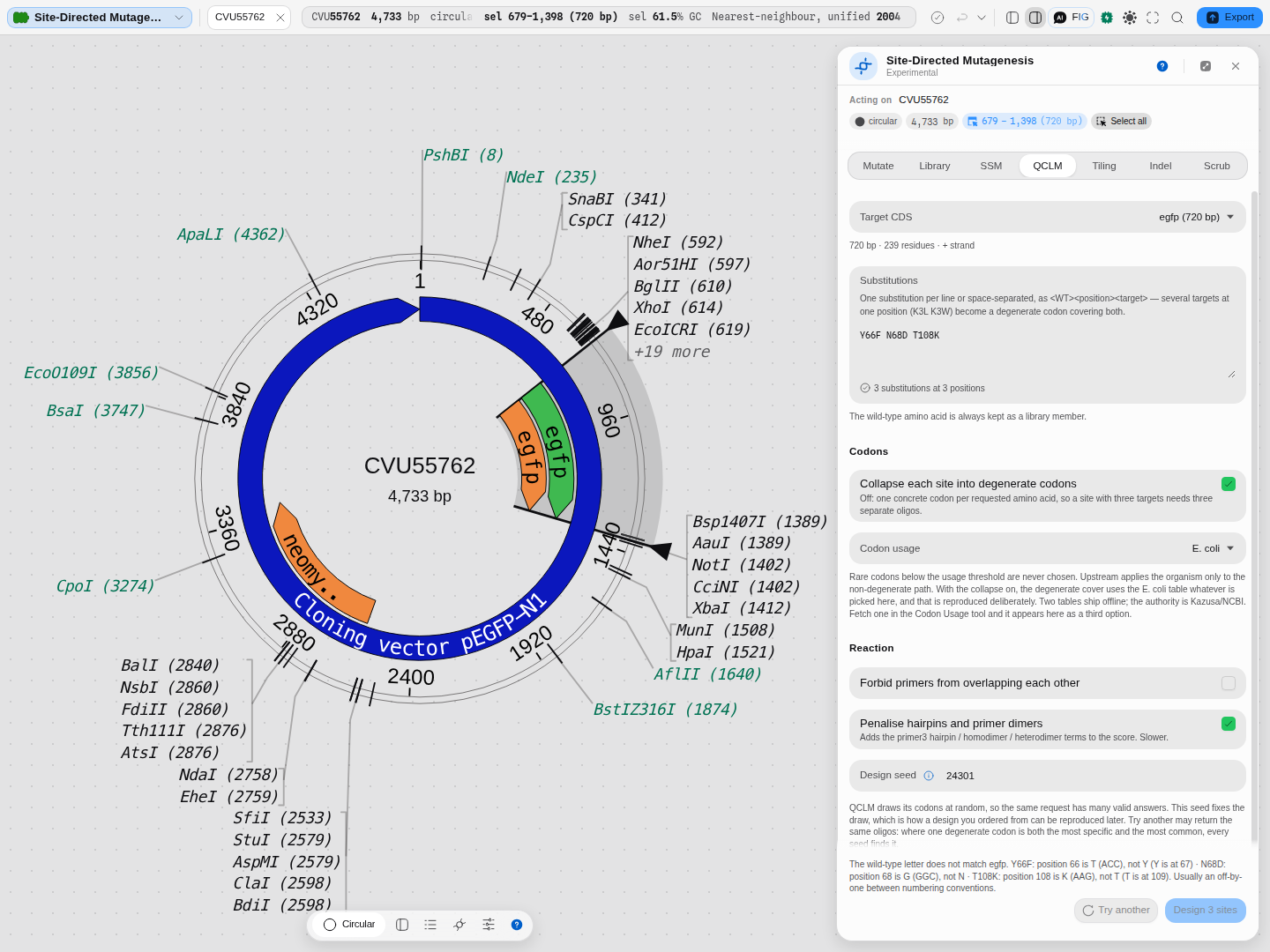
Try Y66F instead of T66F and the design is refused before it runs: residue 66 of this
construct is threonine, and the message says so and points at 67, where the tyrosine you meant
actually is. That is not a bug in either the record or the tool — it is the well-known off-by-one
between the classic GFP chromophore numbering and the numbering of this particular vector's coding
sequence, and it is exactly the mistake the check exists to catch before you spend money on oligos.
It is refused rather than warned about because of what QCLM would otherwise return. Every site
carries the unchanged codon as a library member, and that member's codon is read off your
template rather than from the letter you typed. Ask for K107L on a construct whose residue 107 is
already a tyrosine and you get two oligos back: the leucine you wanted, and a second one labelled
K107Y whose bases are identical to the template, reported as a successful design. That oligo
mutates nothing.
Controls
| Control | What it changes |
|---|---|
| Target CDS | The coding sequence the positions are counted in. Shared with the other tabs, so a gene picked once stays picked. |
| Substitutions | The requested changes. Several targets at one position become a degenerate codon covering all of them. |
| Collapse each site into degenerate codons | On: one degenerate codon per site. Off: one concrete codon per requested amino acid, so a site with three targets needs three separate oligos. |
| Codon usage | The organism table rare codons are judged against. Two tables ship offline; fetching one in the Codon Usage tool adds it here as a third. |
| Forbid primers from overlapping each other | Prevents two designed oligos from sharing sequence, which some multi-site protocols require. |
| Penalise hairpins and primer dimers | Adds the hairpin, homodimer and heterodimer terms to the ranking. Slower, and worth it whenever the design is GC-rich. |
| Design seed | Fixes the random draw, so a design you ordered from can be reproduced later. |
| Show every solver parameter | Reveals the geometry and temperature windows the solver is working inside: for primer length, 5′ arm, 3′ arm and GC content, the minimum, the optimum and the maximum; the temperature scan bounds, step and window width; the codon-frequency floor; and every scoring weight. |
| Optimum (per window) | The value the score is a deviation from, not the midpoint of the window. It decides the ranking among candidates that all pass the window, so changing one changes which design wins without changing which designs are legal. An optimum outside its own window is refused by name rather than run. |
| 3′ GC clamp | How many G or C bases the 3′ end must carry. A clamp helps the polymerase start cleanly; raising it narrows the legal set, and on a GC-poor stretch can empty it. |
Algorithms you can choose
This tab offers one solver, deliberately: the multi-site codon solver, run either with the degenerate collapse on or off. Those two are genuinely different questions rather than competing answers — the collapse asks "what is the smallest oligo set that covers these residues", and the concrete path asks "give me one named codon per residue I asked for" — so both ship and the switch is on the panel rather than buried.
One property is worth stating because it is not obvious: the solver draws codons at random, so the same request has many valid answers and a re-roll may return a different oligo set. Where one degenerate codon is both the most specific and the most common choice, every seed finds it and the answer does not change. The seed is shown for exactly this reason.
The rare-codon threshold applies to the concrete path only. With the collapse on, the degenerate cover uses its own table whatever organism you pick — a deliberate behaviour, stated on the panel rather than hidden.
The science
Multi-site mutagenesis of this kind is a one-tube variant of the QuikChange family: mutagenic oligonucleotides anneal to the template, a high-fidelity polymerase extends them, and the parental methylated template is digested away. What makes it hard is that every oligo has to work under the same thermal program, so the design problem is a joint one — you are not picking the best primer for each site, you are picking the best set.
The thermodynamics here are the same nearest-neighbour and hairpin/dimer calculations the rest of the workbench uses, so a melting temperature quoted on this page means the same thing as one quoted in the primer designer. The designs it returns are checked against the published multi-site designer this method comes from, case for case.
Limitations
- The design is randomised, so it is reproducible only through its seed. Record the seed with anything you order.
- Amino-acid coverage can read below 100% when a wild-type letter does not match the sequence: the "no change" oligo then takes its codon from the template and is labelled with the residue the template actually has. The warning above the result says so; the coverage number is honest rather than flattering.
- Sites too far apart cannot be merged at any oligo length, and the solver will say so rather than emit an oligo that cannot anneal.
- It designs substitutions only. Insertions and deletions are the Indel tab's job.
Export
The oligo set copies as sequences and exports as CSV. Add oligos to the map writes them to the record as primer features, which then travel with the file through GenBank export like any other annotation. Nothing is written to the record until you confirm.
Automation
The same engine is available to the workflow builder and to the copilot, so a multi-site design can run as a step in a pipeline over many constructs rather than one panel at a time.
Provenance
A run records the target, the requested substitutions, the seed and the resulting oligos in the project's step log, so a design can be traced back to the request that produced it months later.
Screenshots
Related
In this group: Restriction Digest · Ligation · Gibson Assembly · Golden Gate Assembly · Grammar Assembly · Assembly Plan · Recombination Cloning · Site-Directed Mutagenesis · Site-saturation mutagenesis
Site-saturation mutagenesis
Pick the residues you want to randomise and get the primer pairs that saturate them in one reaction.
Primer Designer
Design primers against a region of an open sequence and see the numbers that decide whether they will work: nearest-neighbour melting temperature under stated salt conditions, GC content, and the free energy at the 3-prime end.