Protocol
A construct's recorded build read top to bottom as numbered sentences, followed by the steps you write on the sequence that is open now. Each step is a sentence whose words are its settings, and its answer sits directly under it.
What it does
A file made in a tool that records its build (SnapGene, QUEEN, OpenCloning, SBOL, or this workbench's own cloning tools) carries how the construct was made. The Protocol leads with that record: PCR pREP42-MCS+ to make Linearized_Vector, Gibson Linearized_Vector + Fragment to make gibson_assembly, one sentence per reaction, with each product's size and topology where the record carries one.
Below the record come the steps you write yourself. Choose a verb under Next, … and a sentence appears: Cut pUC19 with EcoRI, Amplify lacZα with primers near 60 °C, Find open reading frames of at least 300 bp on both strands. Change a word and the answer under it is computed again. A step that changes the molecule (moving the origin, flipping the strands) changes it for every step below, so a digest written after a flip is a digest of the flipped molecule.
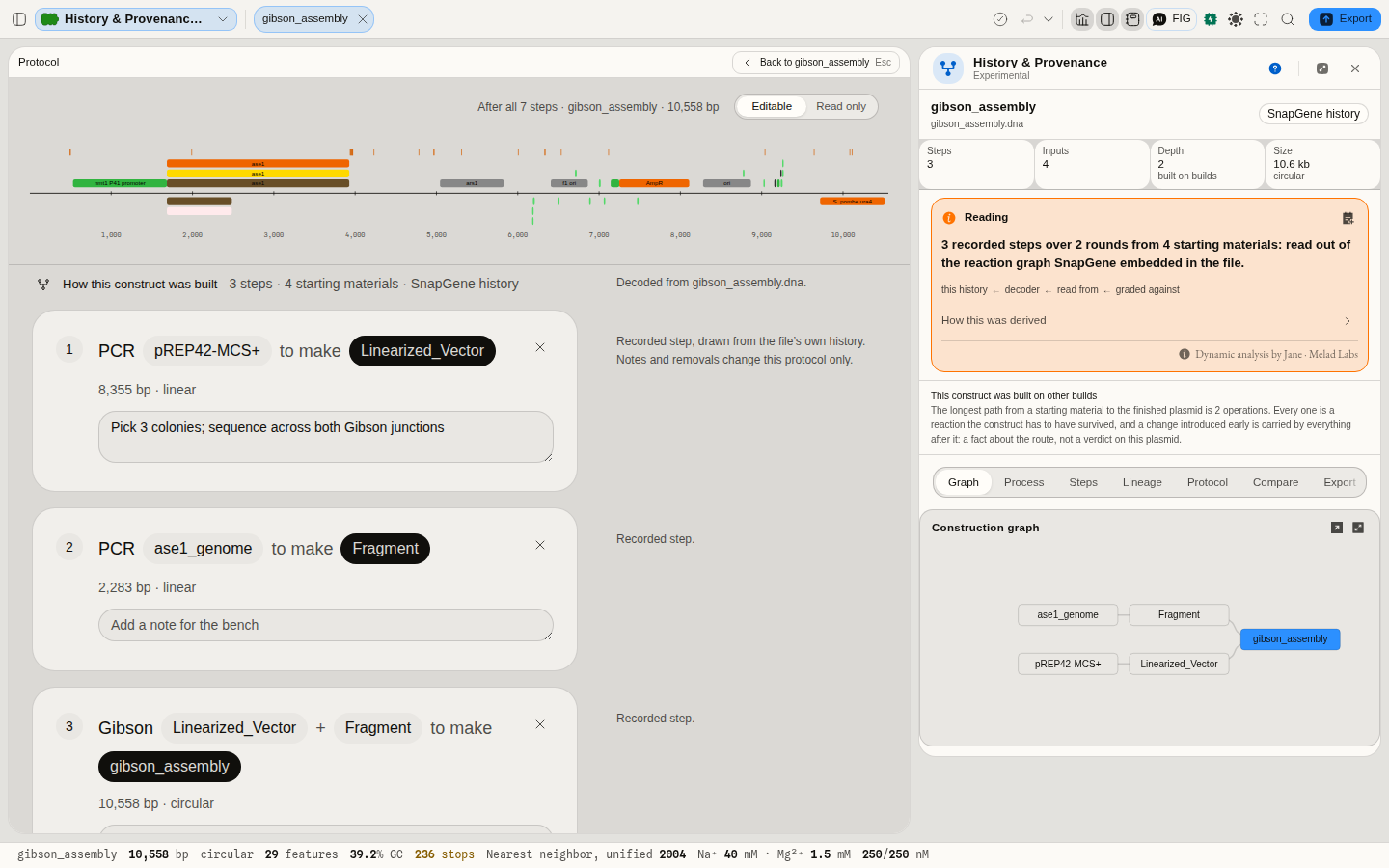
gibson_assembly.dna carries its own reaction graph, read as three sentences: two PCRs and the
Gibson assembly that joins their products, each with its product's size and topology. The first
step has a bench note. The ribbon pinned above is the finished 10,558 bp plasmid.
When you'd use this
- When you inherit a plasmid. Open the file and the build it carries is a protocol you can read as a bench would, without reconstructing it from a graph.
- To write down what to do next. Notes on a recorded step (which colonies to pick, which junctions to sequence) stay with that step in this project.
- To check a construct before ordering anything. Open it, cut it, amplify the insert and find its reading frames in one column, each answer beside the sentence that asked for it.
What this computes
- Recorded steps: the operation, its input molecules, the enzymes where a restriction step names them, the product, and the product's length and topology when the record states them
- Open: the molecule's length, topology, GC content, feature count by type and single cutters (enzymes that cut exactly once)
- Cut: a complete digest on a circular or linear template, with the cut count, every fragment with its ends and size, and a band picture on a log size axis (a picture of the sizes, not a migration model)
- Amplify: a primer pair for a feature, each primer grown from the feature's end until it reaches the target Tm, with each primer's length, Tm and GC, and the pair's product size, product GC and annealing temperature
- Find ORFs: every open reading frame from ATG to a stop in all three frames of the chosen strands, across the origin on a circular template, longer than the minimum length
- Translate: a feature's protein sequence under the standard genetic code, read from the
feature's own strand, stops shown as
* - Scan GC: GC content in consecutive windows of the chosen size, against the whole-molecule value
- Move origin: the molecule rotated so the base after a single cutter's cut becomes position 1, with every feature's new coordinates
- Flip strands: the reverse complement of the whole record, every feature mirrored onto the other strand
A ribbon of the molecule stays pinned above the steps and lights up whatever the step under the pointer is about: the cut sites, the primers, the reading frames or the window.
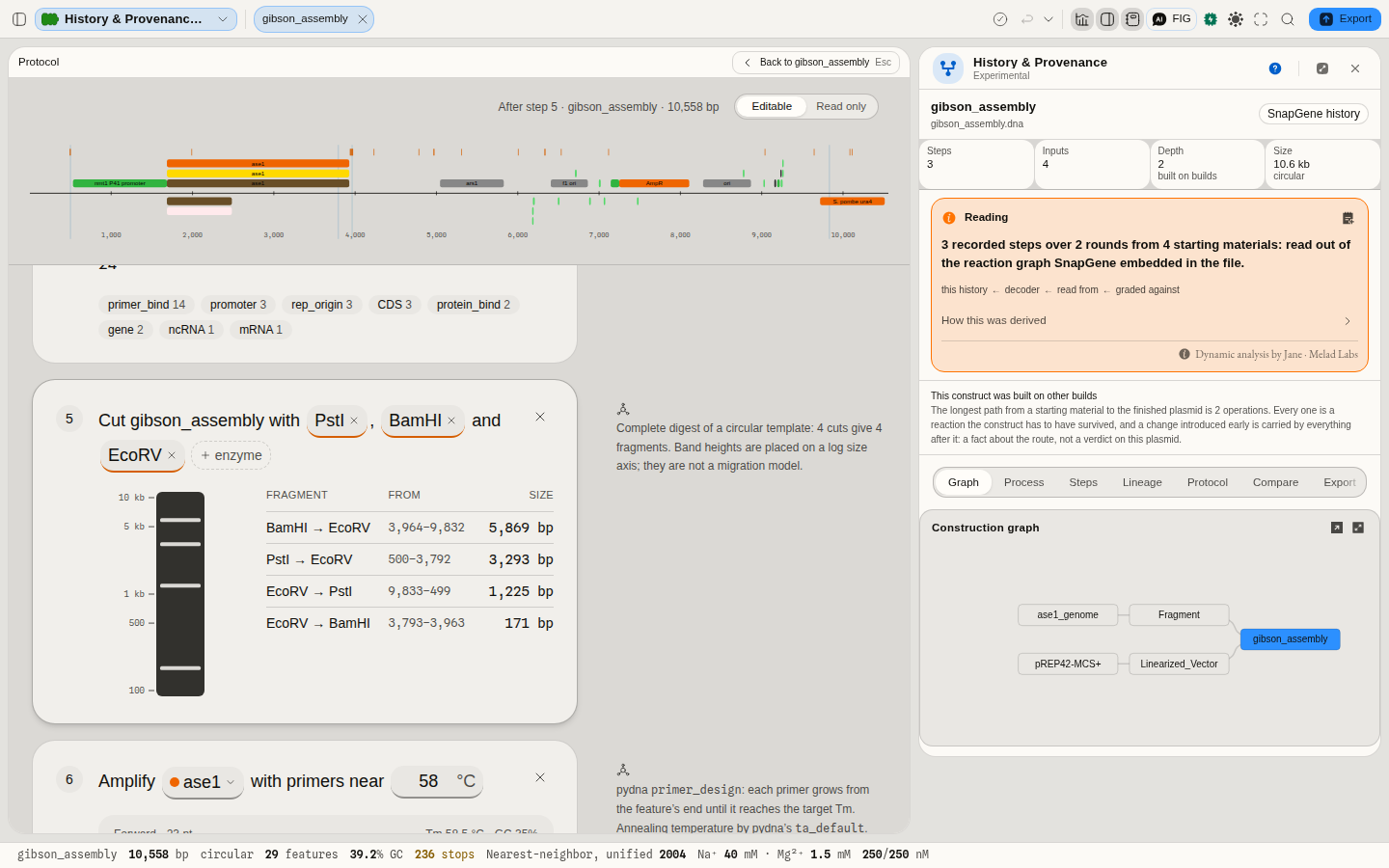
Cut with PstI, BamHI and EcoRV: four cuts on the circular 10,558 bp plasmid give four fragments, 5,869, 3,293, 1,225 and 171 bp, each named by the enzymes at its two ends. The pointer is on the step, so the ribbon above marks the four cut sites.
Editable and read only
Editable is the default: every sentence can be changed, a recorded step takes a note, and Remove takes a recorded step out of this protocol (Put back returns it). Read only puts every control away and shows the notes as text, for reading at the bench. The recorded history itself is never rewritten: a note or a removal changes this protocol, not the file.
Where it lives
The Protocol rises over the canvas, between the side panels, and follows the document in the active tab. The notebook button in the top bar opens and closes it. Opening History & Provenance opens it too, and opening a document that carries a recorded build offers it once.
Pitfalls
- A recorded build is a claim about what was intended, not proof of what is in the tube. Only sequencing says the plasmid matches.
- A history that belongs to another file is not shown here. When a document records no build of its own, the Protocol starts at the document itself rather than borrow a sibling's history.
- Notes are not exported. The exported protocol is written from the recorded history alone.
Construction graph
A construct's build history drawn as the graph it is — every starting molecule, every intermediate and every reaction, on one canvas you can pan and zoom.
Read Quality Profile
Mean Phred, the fraction of the read above Q20 and Q30, the whole-read quality curve with the trimmed ends shaded, and the count of mixed peaks.