
LAMP primer design
Marked experimental: the surface can change.
Design a complete LAMP primer set against a region of an open sequence: the four core primers (F3, FIP, BIP, B3), the two optional loop primers (LF, LB), and every measurement that decided them.
| Reached by | Tools → Primer Designer → LAMP · command palette → LAMP primer set · right-click a selection → Primers → Design a LAMP set in this selection |
| Sample project | Primer test — open NC_004718, the SARS coronavirus genome, and select the N gene |
What LAMP is, and when you would reach for it
Ordinary PCR needs a thermal cycler: the reaction only proceeds because you drive the temperature up and down to melt the duplex. Loop-mediated isothermal amplification does not. It runs at a single temperature, around 60–65 °C, because a strand-displacing polymerase does the melting for you, and because the products fold into stem-loop structures that present fresh priming sites without ever being heated apart.
That single property is why LAMP matters: it needs a heat block, not an instrument. It is the method behind most field and point-of-care nucleic-acid tests — a water bath, a colour change, no thermal cycler and no gel.
The cost is the primers. LAMP recognises six distinct regions of your target instead of two, and those six have to satisfy melting temperature, end stability, GC content and a set of distance constraints between each other simultaneously. Designing a set by hand is not realistic, which is why this panel exists.
When not to reach for it. LAMP is a detection method, not a cloning one. It amplifies a 120–160 base window into a ladder of concatemeric stem-loop products of many different lengths — you cannot clone the product, you cannot sequence it straightforwardly, and you cannot read a clean band off a gel. If you want a defined amplicon you can cut, ligate or sequence, use the Design tab next door. LAMP answers "is this sequence present", and answers it fast, with extraordinary sensitivity and no instrument.
What this computes
Per oligo — the sequence to order, its length, its melting temperature under the guide's own conditions (0.1 µM oligo, 50 mM Na⁺, 4 mM Mg²⁺, which are not the same conditions ordinary PCR primers are quoted at), its GC fraction, and the free energy of its terminal six bases, which is the criterion that decides whether an end is stable enough to prime.
Per set — the amplified span from the 5′ end of F2 to the 5′ end of B2; both loop-forming stretches; both outer gaps; and the two composite inner primers written as they are ordered, FIP as F1c+F2 and BIP as B1c+B2.
Per set, as a ranking — a penalty built from eleven measurements, each scored by how far it sits from the middle of its published window, squared and normalised so that 1.0 is the window edge. The panel prints the terms that cost a set anything, largest first, with the value and the window beside each: a set is third because of something you can name, not because a number said so. The ranking is ours; every quantity inside it is measured by the ported engine.
Secondary structure, when you ask for it — hairpin and self-dimer melting temperatures for every oligo in the set, including the two long inner primers, from the same primer3 engine the PCR designer uses. The published guide sets no threshold for these, so they are reported without a verdict rather than being marked pass or fail against a number nobody published.
What is not computed — reaction speed, yield, or whether a set will amplify. LAMP's own authors recommend testing candidate sets experimentally; what a designer can do is enforce the geometry and the thermodynamics, and say which candidate deviates least.
The six regions, and the primers made from them
Along your target, 5′ → 3′, LAMP names six regions in this order:
5'──[ F3 ]──[ F2 ]──[ F1 ]────────[ B1c ]──[ B2c ]──[ B3c ]──3'From them come four primers, and two of them are composite — a single oligo built by joining two non-adjacent pieces:
| Primer | Built from | What it does |
|---|---|---|
| F3 | the F3 region, as written | Outer forward primer. It primes after FIP and displaces the strand FIP made, releasing it to fold. |
| FIP | F1c + F2, joined into one oligo | The forward inner primer. Its 3′ half (F2) primes; its 5′ half (F1c, the reverse complement of F1) is not complementary to anything nearby, so once the strand is displaced it folds back onto F1 and forms the loop. |
| BIP | B1c + B2, joined into one oligo | The same construction on the other strand. |
| B3 | the reverse complement of B3c | Outer backward primer, the mirror of F3. |
| LF, LB | the stretches between F2 and F1, and between B1c and B2c | Optional loop primers. They anneal inside the loops that the inner primers create, which are otherwise idle, and typically cut the time-to-result by a third to a half. Design them unless you have a reason not to. |
The loop is the whole mechanism. Because F1c is carried in on the FIP oligo, the displaced strand ends up with a region complementary to a region further along itself, so it self-anneals into a dumbbell. Every turn of the cycle then presents new single-stranded loops for the inner and loop primers to prime from, with no heating anywhere.
The criteria, and where each number comes from
Every constraint the search enforces is on the panel and adjustable. The defaults are not ours; they are the values published by Eiken Chemical, who invented LAMP and who publish the reference design software, and they are the four things their guide says matter.
Melting temperature. Measured by the nearest-neighbour method, under the conditions the guide specifies — 0.1 µM oligo, 50 mM Na⁺, 4 mM Mg²⁺. Comparing a Tm computed under different conditions against these windows is meaningless, which is why the conditions are fixed to the method rather than inherited from the editor's shared buffer:
| Control (region) | Target Tm |
|---|---|
| Tm · F1c / B1c (inner): the inner halves that form the loops | 64–66 °C |
| Tm · F2 / B2 / F3 / B3 (outer): everything that primes or displaces | 59–61 °C |
| Tm · LF / LB (loop): the loop primers | 64–66 °C |
The inner halves sit ~5 °C hotter on purpose: the loop must form and stay formed at the reaction temperature, before the primer that made it can be extended.
End stability. The end of a primer is where synthesis starts, so it has to be held down. The free energy of the terminal 6 bases must be −4 kcal/mol or lower — at the 3′ end for F2, B2, F3, B3, LF and LB, and at the 5′ end for F1c and B1c. The 5′ case looks odd until you follow the mechanism: after the first round, the 5′ end of F1c has become the 3′ end of F1, and it is that end which then has to prime.
GC content. 40–65%, with 50–60% giving the best primers in practice.
Distances. These are what make LAMP design hard, because they couple the six regions to each other:
| Control (distance) | Window |
|---|---|
| Amplified region (F2 5′ → B2 5′) | 120–160 bases |
| Loop-forming stretch (F2 5′ → F1 5′): the stretch that becomes the loop | 40–60 bases |
| Outer gap (F3 → F2, B3 → B2) | 0–60 bases |
Two of these numbers are disputed, and the panel says so. Eiken's design-software guide gives the amplified region as 120–160 bases and the outer gap as 0–60; Eiken's own LAMP website gives 120–180 and 0–20. Both are shipped: the guide's values are the defaults, because they are what the reference software actually enforces, and the website's are one edit away in the same controls. If no set is found on a target you believe in, widening the amplified region toward 180 is the first thing to try.
Presets: the target picks them, unless you say otherwise
Before searching, the panel measures your target's GC content and selects one of three published parameter sets, exactly as the reference software does:
| Target | Classified as | Binding-region length | GC |
|---|---|---|---|
| GC < 45% | AT rich | 18–25 nt | under 45% |
| 45–60% | normal | 18–25 nt | 40–65% |
| GC > 60% | GC rich | 15–22 nt | over 60% |
An AT-rich target needs longer primers to reach the same Tm; a GC-rich one needs shorter ones to avoid overshooting. The panel names the preset it picked before you run, so you can see the choice being made. Override the automatic preset turns the windows into controls you set yourself, Binding-region length among them.
Step by step
The walkthrough below uses the Primer test sample project, which carries the real SARS coronavirus genome (NC_004718) for exactly this purpose. LAMP is a diagnostic method and its criteria are tuned to pathogen targets, so a cloning plasmid is the wrong molecule to learn it on.
1 — Open the target and choose your window. Open the sample project, open sars.gb from the
file list, switch the canvas to Circular, and click the N feature. That is the nucleocapsid gene,
28,120–29,388 — the classic LAMP and RT-LAMP target for a coronavirus, because it is abundantly
transcribed and comparatively conserved. The status bar confirms sel 28,120–29,388 (1,269 bp).
If you already know the coordinates — from a paper, an alignment, or a previous run — you do not have to find them on the map: Set range… in the Target section takes them as numbers, 1-based and inclusive, and moves the selection for you. It is the same selection either way, so the map, the status bar and the design always agree about what is being amplified.
2 — Open the LAMP tab. Tools → Primer Designer, then the LAMP tab; or press the command palette and type LAMP, which opens the panel already on it.
The Target section now reads back what it is working with: the length, and the preset the GC content selected. On this region it reports 1,269 bases and the normal (45–60% GC) preset — and, because NC_004718 is an RNA genome, it also states that the record is read as its cDNA and that what you are designing is an RT-LAMP set. That is not a technicality: RT-LAMP reverse-transcribes the target first, and the six primers are DNA oligos annealing to that cDNA, which is why the design runs on DNA thermodynamics.
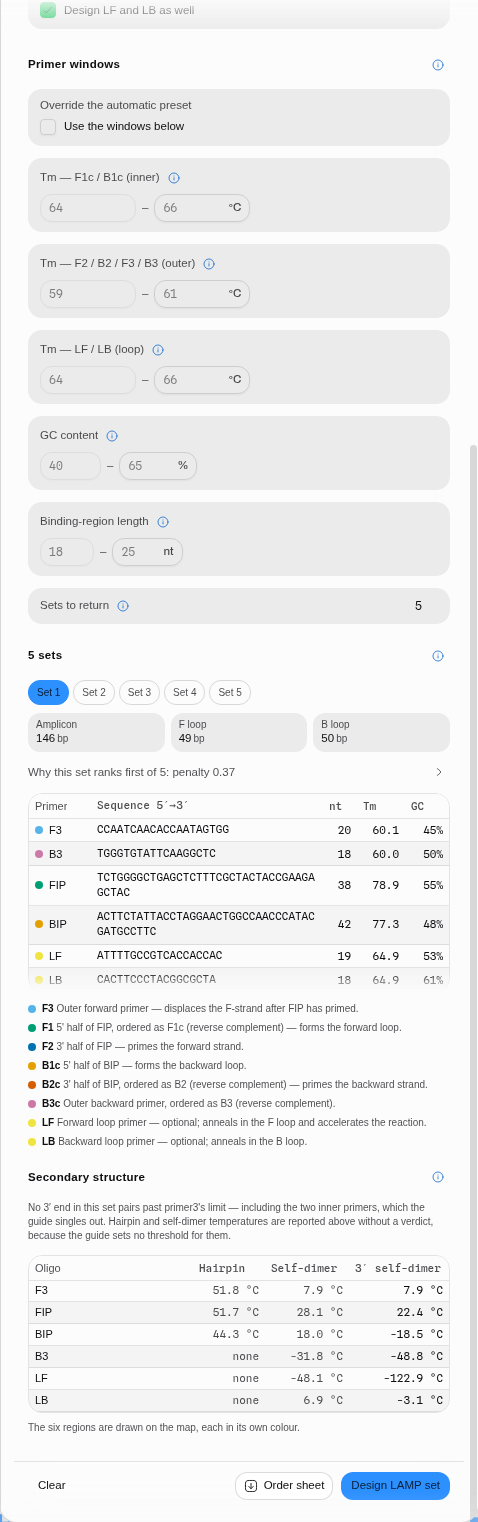
3 — Check the geometry, or leave it. The three distance windows are the published defaults. Leave Design LF and LB as well on unless you have a reason not to — loop primers are close to free and they make the reaction substantially faster.
4 — Run it. Press Design LAMP set. On this target it returns five sets, ranked best first, where "best" means every measurement sits as close to the centre of its published window as possible. The ranking is a transparent sum with no tuned weights in it.
5 — Read the set. Set 1 on the N gene gives a 146 bp amplified region with a 49 bp forward loop and a 50 bp backward loop — all three comfortably mid-window — and these six oligos:
| Primer | Sequence 5′→3′ | nt | Tm | GC |
|---|---|---|---|---|
| F3 | CCAATCAACACCAATAGTGG | 20 | 60.1 | 45% |
| B3 | TGGGTGTATTCAAGGCTC | 18 | 60.0 | 50% |
| FIP | TCTGGGGCTGAGCTCTTTCGCTACTACCGAAGAGCTAC | 38 | 78.9 | 55% |
| BIP | ACTTCTATTACCTAGGAACTGGCCAACCCATACGATGCCTTC | 42 | 77.3 | 48% |
| LF | ATTTTGCCGTCACCACCAC | 19 | 64.9 | 53% |
| LB | CACTTCCCTACGGCGCTA | 18 | 64.9 | 61% |
Check yourself against those numbers. Note that FIP and BIP report Tm around 78 °C — that is the whole composite oligo, and it is not what the 64–66 °C window applies to. The window applies to the two halves separately, because the halves anneal separately and at different moments in the reaction.
6 — Look at the map. Selecting a set draws its regions on the canvas, each in its own colour and each labelled: F3, F1, F2, B1c, B2c, B3c, LF and LB, under the grey bar marking the amplified region. The view moves to the target so the marks are actually in front of you — on a 29,751 base genome a 146 base amplicon is a fifth of a percent of the molecule. Hovering any mark says what that region is and which oligo it is ordered as, so the map answers "which piece is this" without the panel.
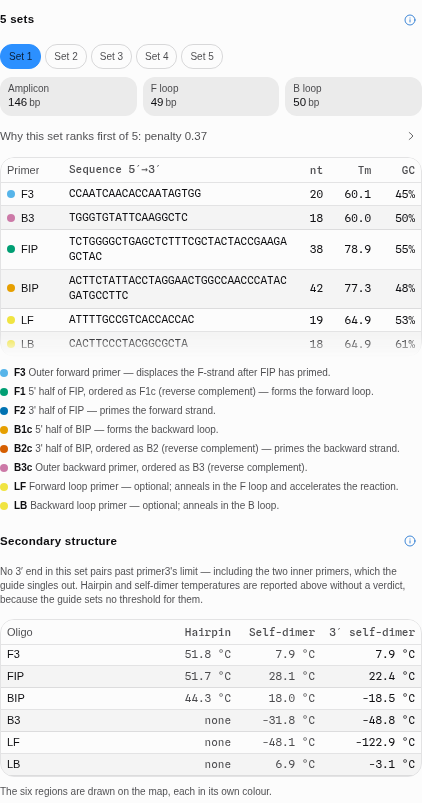
7 — Check the structures. Below the set, Secondary structure folds each of the six oligos and pairs them against each other. This is the fourth of the guide's key factors, and it is the one it states without a number: it says primers must not form secondary structures — "particularly for the Inner primer" — and that 3′ ends must not be complementary, but publishes no threshold. So the readout names both authorities: the rule is Eiken's, and the limits each measure is judged against are primer3's own documented defaults.
Three columns per oligo: hairpin (does it fold back on itself), self-dimer (does it pair with a copy of itself anywhere), and 3′ self-dimer (does it do so through its 3′ end — the configuration that actually extends into primer-dimer). Anything over its limit is coloured and also spelled out in words underneath, and the worst cross-pair in the set is named with its temperature.
FIP and BIP get called out separately when they are the ones flagged, because that is what the guide warns about: they are 38–45 nt of two joined binding regions, so they fold more readily than anything else in the set. If an inner primer is flagged, take another set — the ranking gave you five.
8 — Order them. Order sheet exports the six oligos as CSV — name, sequence, length, Tm, GC, and whether each is a core or an optional loop primer, so a synthesis order does not need you to remember which four are the mandatory set.
Pro tips and pitfalls
- Design on a window, not on a genome. Select the gene, or a few hundred bases of it. Targets over 2,000 bases are refused with that reason on screen: the search is exhaustive over start positions, and LAMP amplifies 120–160 bases, so a genome-wide search is answering a question nobody asked.
- If nothing is found, widen the amplified region first. Of the three distance windows it is the one the two published sources disagree about, and going from 160 to 180 opens up substantially more of the search space than loosening a Tm window does.
- Do not compare these Tm values against a Tm from elsewhere in the app. These are computed at 0.1 µM oligo, 50 mM Na⁺, 4 mM Mg²⁺ because the LAMP criteria are defined at those conditions. The same primer under a PCR buffer will report a different number, and neither is wrong.
- The inner primers are long, and that is correct. FIP and BIP come out at 38–45 nt because each is two binding regions joined end to end. Do not "fix" a long inner primer by trimming it; you would be deleting half of a primer that has two jobs.
- Loop primers are optional, and an absent one is an honest answer. If no LF or LB satisfies the criteria in the loop that set creates, the set comes back without it rather than with a poor one. The four core primers are still a working set.
- A LAMP design is not a specificity guarantee. Six regions matching is far more stringent than two, which is why LAMP is specific in practice — but this panel designs against the sequence you gave it and does not screen the set against a genome or a background flora. Confirm specificity before you trust a diagnostic result.
- A structure flag is a reason to take the next set, not to edit the primer. The six regions are interlocked by the distance constraints, so trimming a flagged oligo by a base breaks the geometry that made it a valid set. Switching sets re-runs the whole design under the same criteria.
- RT-LAMP on an RNA target needs a reverse transcriptase in the tube. The panel tells you when it has read an RNA record as cDNA; that is a statement about the design, not about your reaction mix.
What this offers that the incumbents do not
The reference design tool is a web service: you paste a sequence into a browser form, away from whatever you are actually working on, and you get primers back as text. Here the LAMP designer is a tab of the editor, which changes what you can do with it:
- It designs on your live selection. Click the gene on the map and the panel is already targeting it — no copying sequence between windows, and no risk of pasting the wrong region.
- The set draws on the canvas. All six regions land on the map as coloured, named marks in the linear, circular and sequence views, so you can see where the amplicon sits relative to every other feature of your construct instead of reading coordinates off a table.
- Every criterion is a control, and both disputed values are shipped. The published windows are on the panel rather than buried in an options dialog, and where the two authoritative sources disagree you get both numbers and the choice, rather than one of them silently.
- It states what it did to your input. The preset it selected, the length it is working on, and whether it read an RNA record as cDNA — before you run, not after you wonder.
- Secondary structure is measured, not assumed. The guide names it as a key factor and gives no number to check against; here every oligo is actually folded, with primer3's own engine, and judged against primer3's documented limits — with both authorities named on the panel so you can see which half of the check is whose.
- It refuses with a reason. A target that is too short, too long, or not unambiguous DNA is rejected next to the control that chose it, naming what is wrong. An empty result table is never how you find out your input was unusable.
What it hands to and takes from other tools
- Takes its target from the editor selection, a whole open sequence, or pasted bases — including from a right-click on the map.
- Hands its regions to the canvas, on the shared amplicon track. Any tool that draws amplicons (PCR, multiplex, the primer-library screen) shares that track, so a later run replaces these marks; every mark's tooltip names which tool drew it.
- Hands the set to synthesis as a CSV order sheet.
Provenance
The design criteria — every temperature, energy, percentage and distance above — are Eiken Chemical's, from the guide published with the reference LAMP design software, cross-checked against Eiken's own published description of the method. Where those two disagree, both values ship and the panel names which is which.
The measurements underneath are not ours either. Melting temperature comes from the nearest-neighbour model checked against Biopython's, and end stability from primer3's own nearest-neighbour calculation, checked against primer3 itself. What is ours is the search that combines them, and every set it returns is verified against every published criterion by an independent recomputation before it can ship.
Related
- Primer Designer — the PCR primer designer in the neighbouring tab.
- PCR simulation — for a defined amplicon you can cut, clone or sequence.
- Melting temperature — the shared Tm conditions used elsewhere in the editor.
Primer Designer
Design primers against a region of an open sequence and see the numbers that decide whether they will work: nearest-neighbour melting temperature under stated salt conditions, GC content, and the free energy at the 3-prime end.
Bisulfite primer design
Find the CpG islands in a sequence, then design the primers that read methylation in one: BSP for sequencing both alleles, MSP for a band that is itself the answer.