Fusion PCR
Marked experimental: the surface can change.
Collect the fragments you intend to join, from the open sequence, the current selection or pasted bases, and fuse the ones whose ends actually overlap.
| Reached by | Tools → Fusion PCR |
| Sample project | PCR, multiplex & fusion |
What it does
Fusion PCR — overlap-extension PCR, SOEing — joins two or more DNA fragments without a restriction site, a ligase or a vector. You give each fragment a tail matching the neighbour it should join, and in the reaction those tails anneal, each strand primes on the other, and the polymerase extends across the join. The panel does that on paper: it takes your fragments, finds which of their ends genuinely share terminal homology, and fuses those into the larger molecule the reaction would produce.
The word doing the work is genuinely. A fusion design is a set of intentions expressed as tails, and the failure mode is that a tail is too short, on the wrong end, or on the wrong strand — none of which is visible by reading the sequences. So the panel does not take your ordering on trust. It tests every pair of fragments in all three relative orientations, joins the ones that actually overlap by at least the length you require, and repeats until nothing further can join. What comes out is the product of the fragments as they are, not as they were meant to be.
If nothing shares enough homology, that is the answer, and it says so with the number it was applying.
When you'd use this
Used in: Design primers, simulate the PCR, and predict the band
- Seamless joins. Fusing a promoter to a coding sequence, or two domains into one open reading frame, with no scar and no site left behind — the case where a restriction strategy would leave codons you did not choose.
- Site-directed mutagenesis by overlap. Two amplicons carrying the same mutation in their overlapping tails, fused into one full-length product.
- Checking a design before you order the tailed primers. The tails are the expensive part and the part that goes wrong. Fusing the two intended amplicons on screen tells you whether the overlap you designed is long enough to be found.
- Building a construct from parts that have no shared sites, where Gibson or Golden Gate is not available or not wanted.
What this computes
The fusion the fragments as they are would give, not the one the design intended.
- Every pair of fragments tested in all three relative orientations, joined where the ends genuinely share at least the terminal homology you require, and repeated until nothing further can join. What comes out is the product of the sequences on the bench, not of the ordering you typed
- The fused product's exact sequence, its length and its parts list — which fragment contributed which stretch, in the order the reaction would build them, and which of them was flipped to make the join
- Each join's overlap: its length in bp and its sequence, so a design that fused on 15 bp of chance homology rather than the 30 bp tail you added is visible as a number rather than a suspicion
- The refusal, with the threshold it applied, when no two ends share enough homology — the panel names the number it was requiring, so a failure tells you which side of the line you are on rather than leaving you to guess it
- How close it came, when it came close. "No fusion" is two different situations with two different fixes, and they are reported as two different answers. If the ends share nothing, the reading says so, and the fix is to design a tail. If they share homology that simply falls under your minimum, the reading names the pair, the length they actually share, and how many bases short they are — so a 20 bp overlap refused by a 60 bp minimum reads as 40 bp short, lower the minimum to 20 or extend the overlap by 40 bases rather than as a dead end. The measurement is made by running the same overlap search again with the minimum ignored, so it is the engine's own answer rather than a second estimate
- Products that a gel will show but the design did not intend — when more than one arrangement of the ends is compatible, every one is reported with its size, because overlap-extension joins in any orientation that matches and a single expected band is an assumption rather than a result
What it will not do is take your ordering on trust. A tail that is too short, on the wrong end or on the wrong strand is invisible in the sequences and is exactly what this reports.
One scientific parameter, and it is real: the minimum terminal homology. Overlap-extension designs typically use 15–40 bp; the default sits at the low end so a short design is found rather than silently refused. Below about 8 bp a shared end is not evidence of anything — an anchored run of 8 specified bases arises by chance roughly once in 65,000 alignments — so a near miss shorter than that is not reported at all rather than offered as a near miss.
Where it lives
Tools → Fusion PCR, in the right-hand rail, and in the command palette. Fragments are added from the open sequence, from the current selection on the canvas, or as a blank you paste bases into — so an amplicon you just produced in PCR Simulation becomes a fusion fragment without leaving the editor.
Each fragment keeps its own name and its own annotations, and those annotations are carried onto the fused product at their new coordinates. That is the difference between a fusion product you can keep working with and one that is a bare string of bases.
Inputs and outputs
In: two or more fragments, each linear, of any length, from any of the three sources above. One parameter: the minimum terminal homology.
Out: the fused product's sequence, its length, GC and melting temperature; the list of parts it was built from, in the order they were joined and named; the features inherited from every input fragment; and a virtual gel placing the product against a ladder.
What it refuses, and says so. When no two ends overlap sufficiently the panel reports
No fusion — no two fragment ends share ≥N bp terminal homology, quoting the threshold it used, so
the next move is obvious: lower the requirement, or fix the tail. It never returns an empty result
without a reason, and it never silently returns the fragments unjoined as though that were a product.
Demo
No screencast exists for this tool. The worked example below runs on a sample project you can open.
Worked example
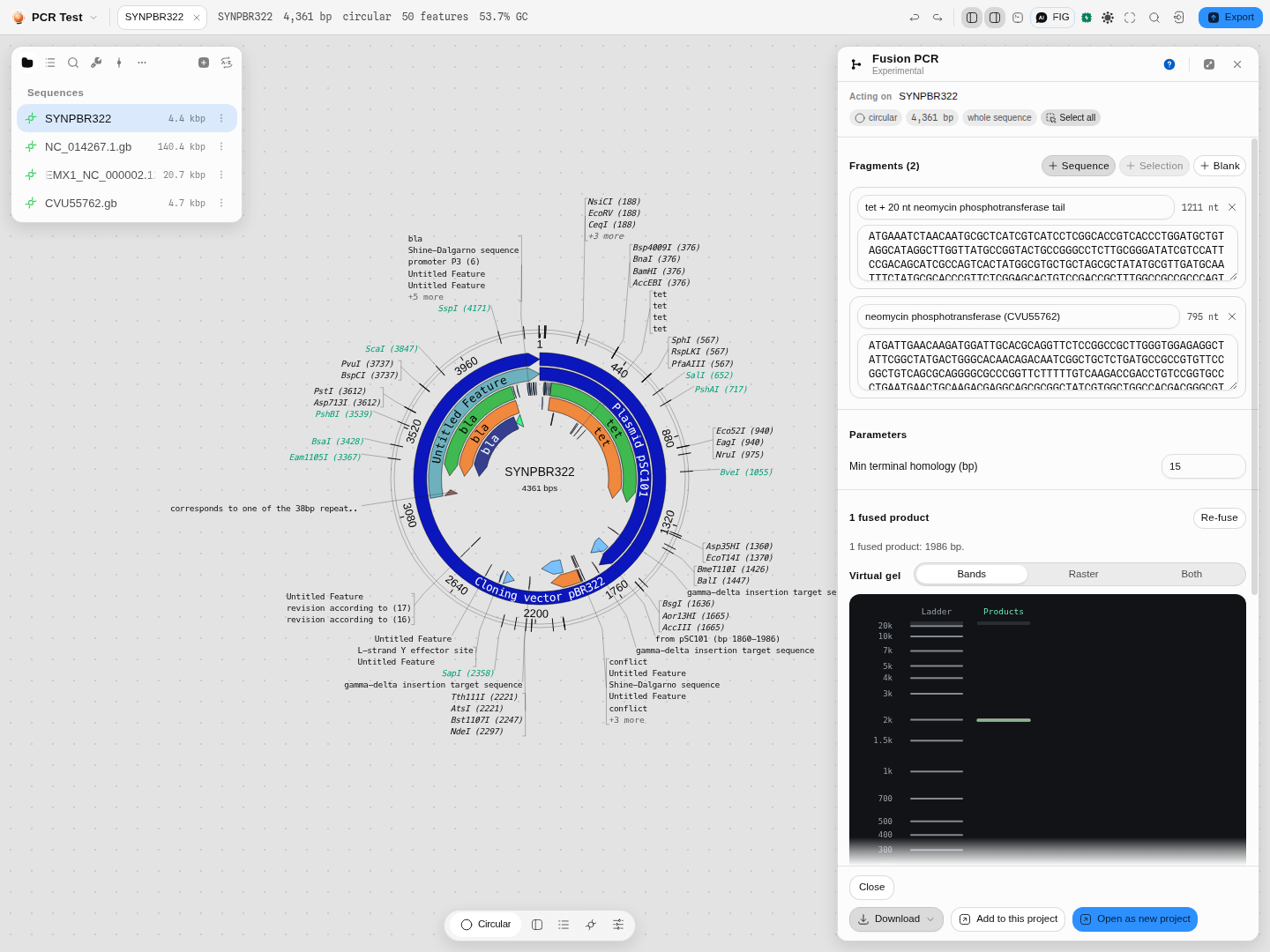
Open the PCR, multiplex & fusion sample project and go to Fusion PCR. It arrives with two real fragments staged, and the important thing about them is that they come from two different plasmids — which is what overlap-extension PCR is actually for. The first is the tetracycline resistance gene amplified from pBR322 with a reverse primer carrying a 20 nt tail matching the start of the second; the second is the neomycin phosphotransferase gene amplified from pEGFP-N1:
| Fragment | From | Length |
|---|---|---|
tet + 20 nt neomycin phosphotransferase tail | pBR322 | 1,211 nt |
neomycin phosphotransferase (CVU55762) | pEGFP-N1 | 795 nt |
Step 1 — check the design before you fuse. Read the two fragment lengths. The first is 20 nt longer than the amplicon it is named for, and that difference is the tail: the homology you are about to rely on. If it is not there, nothing below will work and no error message will tell you why as clearly as this arithmetic does.
Step 2 — set the threshold. Leave Min terminal homology at 15 bp. You designed a 20 nt overlap, so the requirement must sit below it.
Step 3 — press Fuse fragments.
| Result | 1 fused product: 1,986 bp |
| Arithmetic | 1,211 + 795 − 20 = 1,986 — the overlap is counted once, not twice |
| GC | 60.7% |
| Product Tm | 84.4 °C |
| Built from | 2 parts |
| Features carried | 13 |
Step 4 — read the gel. The product's band sits just under the 2 kb marker, which is where you would look for it on a real gel, and it is the only band: one product, not a smear of partial joins.
Step 5 — make it fail on purpose. Raise the threshold to 40 bp and fuse again. The 20 nt overlap
no longer qualifies and you get
No fusion — no two fragment ends share ≥40 bp terminal homology. — the design has not changed, the
question has. This is worth doing once, because it is the message you will meet when a tail really is
too short, and knowing it names the threshold saves you from suspecting the fragments.
Why two plasmids and not two genes off one? Fusing two genes from the same molecule demonstrates the mechanics and none of the reason. In the lab you reach for overlap-extension precisely when the pieces live on different molecules and share no restriction sites you could cut them out with. The sample is built that way so the workflow you practise is the workflow you will run.
The donor gene is chosen by measurement, not by name. pEGFP-N1 carries both egfp (720 bp) and the neomycin phosphotransferase (795 bp); the sample takes the longer one. Point the same sample machinery at a different plasmid and it stages that plasmid's longest gene instead, which is the test that the primers you see were designed and not typed.
Controls
Fragments. Add from the open sequence, from the canvas selection, or blank; rename any of them; remove any of them. The order you add them in does not decide the result — the search considers every pair — but it does decide the names you will read in the parts list.
Min terminal homology (bp). The only scientific parameter, and it is a real one. Too low and fragments will fuse on a chance overlap that no reaction would use; too high and a legitimate design is rejected. Overlap-extension designs typically use 15–40 bp of shared sequence, and the default sits at the low end of that so a short design is found rather than silently refused. Because the threshold is explicit, a failure tells you which side of it you are on.
Algorithms you can choose
One method, deliberately. Overlap-extension has a single well-defined outcome: the fragments that share terminal homology join, in the orientation in which they share it. There is no second model to choose between, so instead of a selector the panel exposes the threshold — the only number the answer actually depends on.
What it does search over is orientation. Each pair is tried as given, with the second fragment reverse-complemented, and with the first reverse-complemented, because a tail added to the wrong end of an amplicon is one of the commonest design slips and the reaction does not care which way round you were thinking.
The science
In an overlap-extension reaction, two fragments sharing complementary ends anneal to each other through those ends. Each acts as a primer on the other, and the polymerase extends both, producing a single full-length duplex. Flanking primers then amplify it.
The simulation reproduces the joining step exactly: it looks for a terminal overlap — one at the very ends of the fragments, not an internal repeat, which would not prime an extension — of at least the required length, in any of the three relative orientations. Where it finds one it builds the fused duplex by taking one fragment's top strand and the other's bottom strand staggered by the overlap, which is the molecule the extension actually produces. It then repeats over the resulting set, so three or more fragments fuse in sequence rather than needing to be joined pairwise by hand.
Features from every input are carried onto the product at their new offsets, and identical features arriving from both sides of a join are de-duplicated rather than doubled.
Provenance of correctness. The fusion is verified against pydna, the reference implementation of in-silico cloning, and the terminal-overlap search underneath it is the same one used by the assembly simulations elsewhere in the workbench — so a homology judged sufficient here is judged sufficient there.
Limitations
- The fused product is not drawn on the canvas. Every other prediction in this group draws where it happens; a fusion cannot, because its parts need not come from the molecule you have open, and the product has no coordinates on any one template. The parts list names the provenance instead. If every fragment is a region of the open sequence, that limitation stops being necessary — it is a known gap, not a design decision.
- It models the join, not the amplification. It does not predict whether the flanking primers will amplify the fused product cleanly, or how much of the unfused intermediate you would carry through. Run the flanking pair in PCR Simulation for that.
- No yield, no competition. Where several fusions are possible, all of them are produced; the panel does not tell you which would dominate, because that needs kinetics it does not model.
- Terminal homology only. An internal shared region is ignored, correctly — but that means a design relying on something other than end-to-end overlap is outside what this tool describes.
- Secondary structure in the overlap is not assessed. A hairpin in the shared tail can stop a real reaction that this simulation joins happily. Check the tails in Primer Designer if the overlap is GC-rich.
Compared with other tools
The common alternative is to do this by hand — concatenate the sequences in an editor and trust the tails. That always "works", which is exactly the problem: it cannot fail, so it cannot tell you your design is wrong. Testing the overlap explicitly, and searching orientations, is what turns the operation from transcription into a check.
Against the scarless assembly methods in the workbench — Gibson and Golden Gate — fusion PCR needs no enzyme beyond the polymerase and no vector, and is usually the right answer for joining two or three pieces into one linear product. The assembly tools are better when a vector, many parts, or directional control by defined junctions is involved.
Export
The fused product leaves as FASTA or GenBank — the GenBank carrying every inherited feature — or becomes a sequence you keep working on, either in this project as a new tab beside its parts or as a new project. Both save the file for real and record the same lineage back to the fragments; keeping it here is usually right, because the construct is generally the template for the next step. The virtual gel shows the product against the chosen ladder.
API
Not documented here. This page is about the method; the programmatic entry points live in the API section of the site.
Automation
Available to the workflow builder and to the copilot, so fragments produced upstream can be fused without the panel — the fused product is emitted as a new record, alongside a count of products, so a design that fuses ambiguously (more than one way) is detectable in a pipeline rather than only by eye. Fewer than two fragments is refused with a message naming what to wire in.
Provenance
Opening a fused product as a sequence records the parts it was built from, so the construct carries its own history rather than arriving as anonymous bases. The result is deterministic — the same fragments at the same threshold always give the same product — so a fusion decision is reproducible by recording the threshold you used.
Screenshots
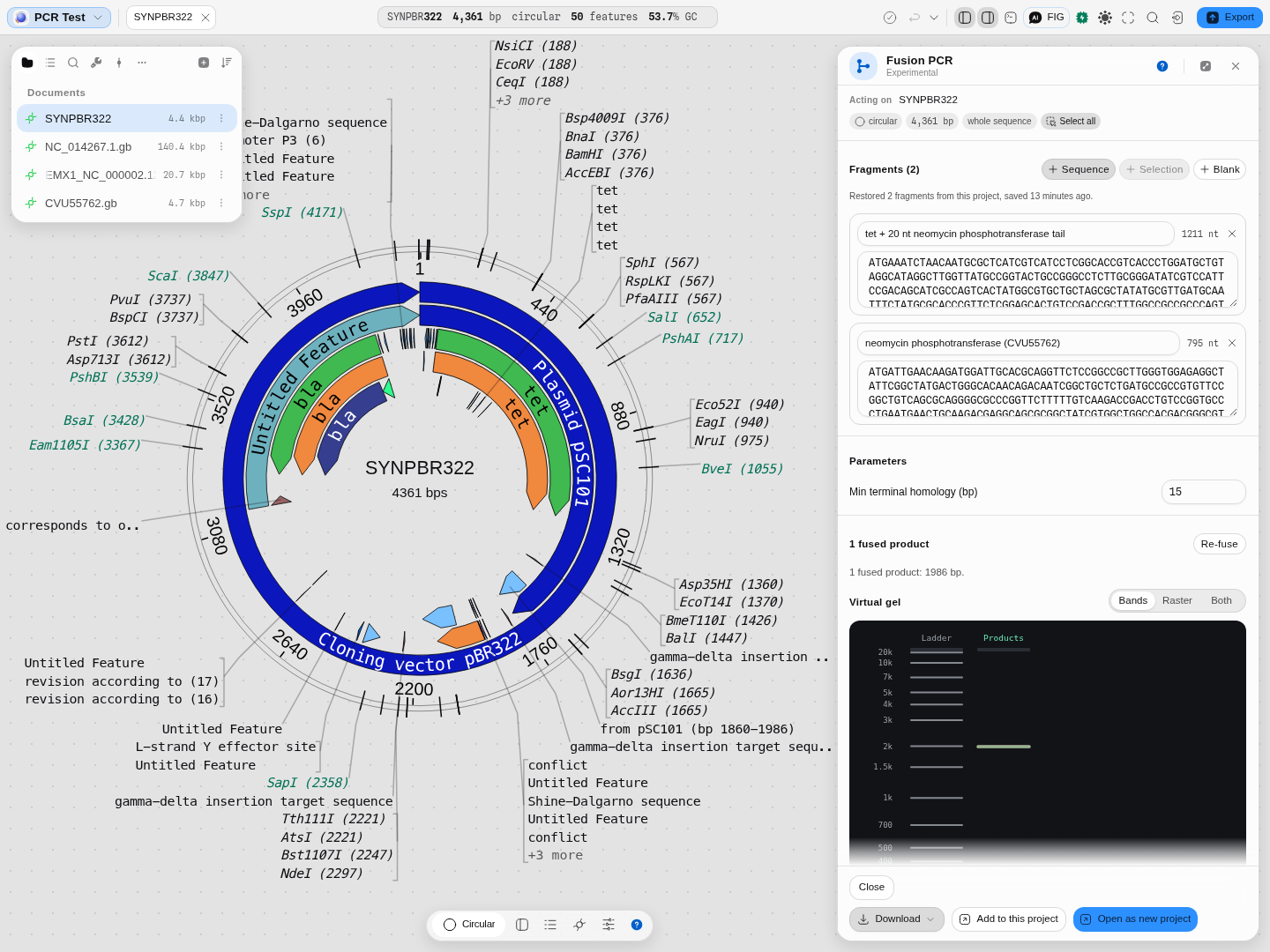 The join succeeded: 1,211 + 795 − 20 = 1,986 bp, with the band where the arithmetic says it should be.
The two halves come from two different plasmids — tet from pBR322, neo from pEGFP-N1, whose
accession the fragment's own name carries — which is what overlap-extension PCR is actually for.
Fusing two genes off one molecule shows the mechanics without the use case.
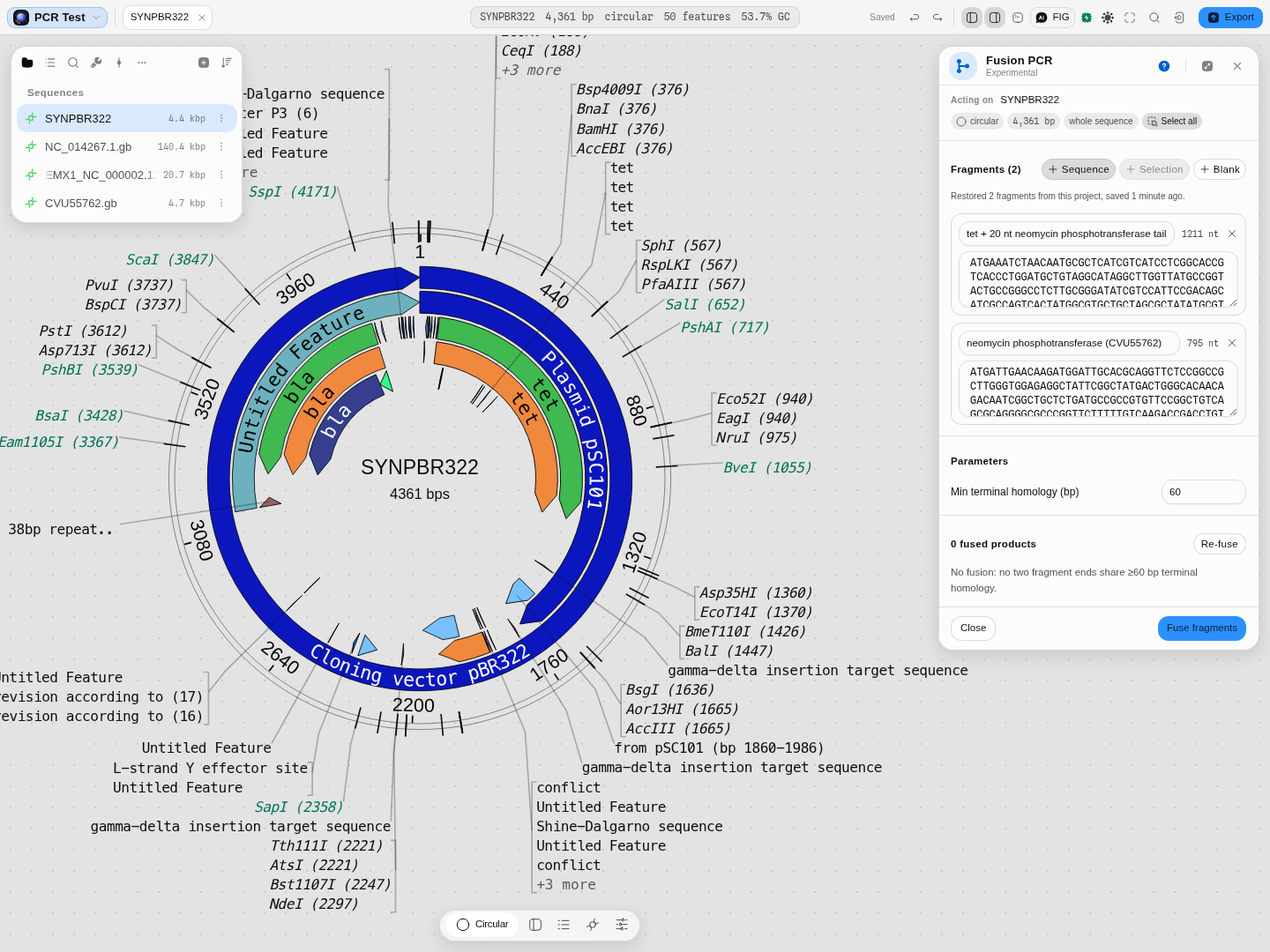 A refusal that names the threshold it applied, so the next move is obvious.
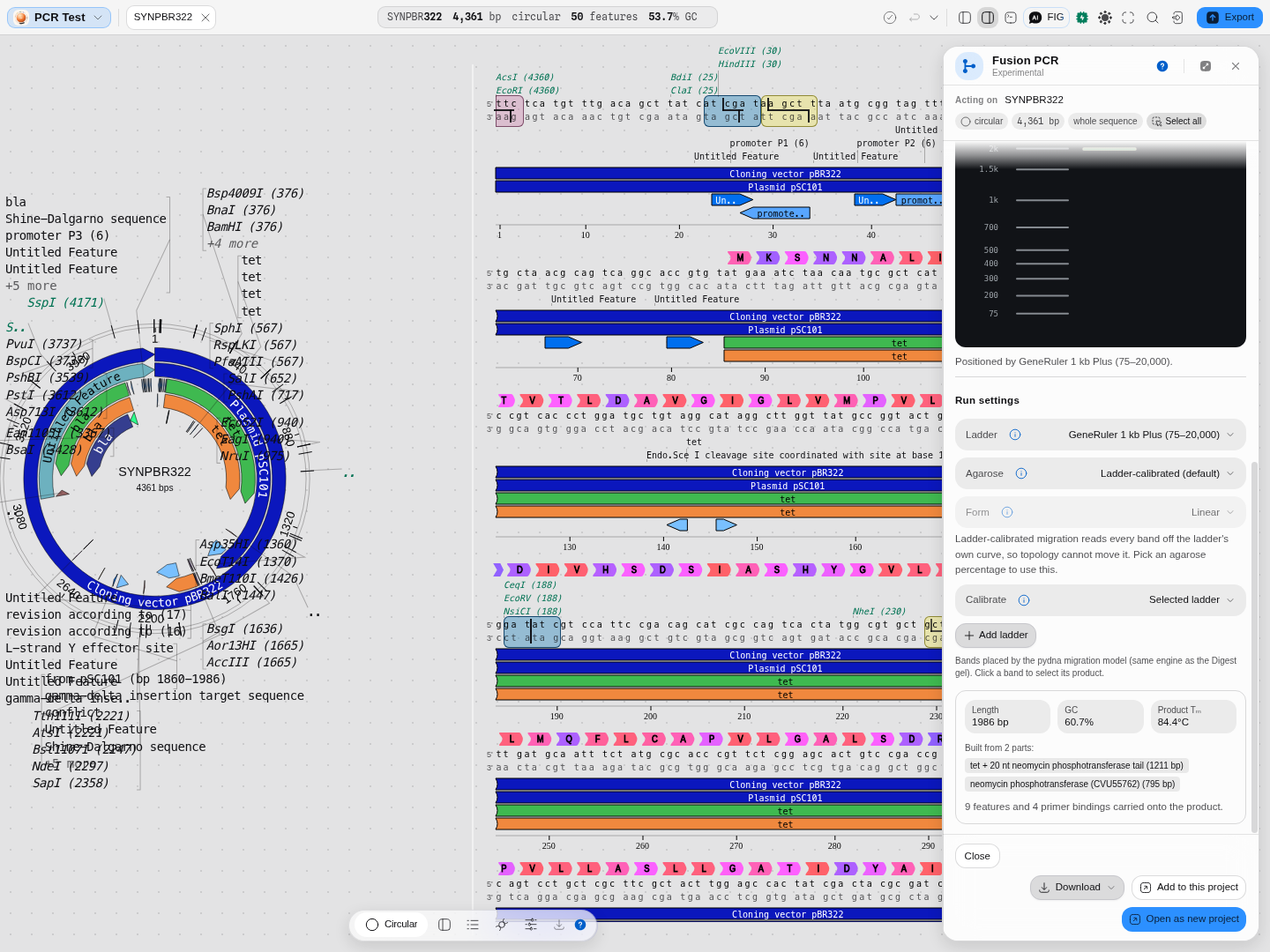 The whole tool still fits a narrowed rail — fragments, threshold, result and gel.
Related
Feeds it: PCR Simulation produces the tailed amplicons, and Primer Designer designs the tails that create the overlap. Follows it: Digest & Gel for the bands, and the cloning tools to place the fused product into a vector. An alternative to it: Gibson Assembly for the same scarless joins with more parts and a vector, or Golden Gate where defined junctions are wanted.
In this group: Primer Designer · LAMP primer set · Bisulfite methylation primers · Degenerate primers from an alignment · CODEHOP hybrid primers from a protein alignment · Primer Library · PCR Simulation · Multiplex PCR · qPCR Design · Digital PCR · Amplification Curves → Cq · Melt Curves → Tm · Droplet gating → concentration · Droplet classification · Melting Temperature