
Search Databases
Ask one question and have it answered by the database that actually owns the answer.
| Reached by | Tools → Analyze |
What it does
Sixty-two public biological databases answer sixty-two different questions, and each of them is the authority on its own. UniProt knows what a protein is; Ensembl knows where a gene sits and which transcripts it has; ClinVar knows whether a variant has been called pathogenic and by whom; ChEMBL knows what a compound binds. This panel puts one query box in front of all of them, keeps the answer in the same window as your construct, and records where the answer came from.
It is a read-only window onto other people's data. Nothing you have open is sent anywhere: a query is the text you typed and, where a source needs one, a coordinate. Your sequence never leaves the machine.
The panel is not a copy of those databases. There is no local mirror to go stale, no curated subset of "supported organisms", no list of accessions we happen to know about. Every answer is fetched from the authority when you ask for it, and every answer arrives stamped with which authority answered, which endpoint it came from, and when.
One authority is the exception, and deliberately so. PanglaoDB does not have an API — it
publishes its whole cell-type marker table as a single file, and its server sends no cross-origin
headers, so a browser cannot fetch it at all. That file ships with the app instead, checksummed
against the copy PanglaoDB published, and the panel marks it bundled. Asking it
cell:B cells or gene:MYC sends nothing anywhere and works on a plane. It is also the reason
there is a starter you can click: every other authority here needs a network, and a sample project
that opens into a connection error would teach you nothing.
When you'd use this
Used in: Align a set of homologues and build a tree from it
Three moments, all of them mid-experiment rather than at the start of one:
- You are looking at a feature and want to know what it really is. A CDS called
neoRin a plasmid map is a name somebody typed. UniProt, InterPro and the Human Protein Atlas will tell you the domain architecture, the isoforms and where it is expressed — without leaving the editor and without re-typing the gene symbol, because the panel can take it from the feature you have selected. - You are about to design against a locus and want the real record first. Before designing guides or primers against a gene, the questions that decide the design are where are its exons, which transcript is canonical, and which positions already carry common variation. Ensembl, MyGene, ClinVar and gnomAD answer those, and the guide designer is one panel away.
- You have a result and need the literature or the trial behind it. PubMed, Europe PMC, OpenAlex, Crossref, bioRxiv and ClinicalTrials.gov are in the same picker as the sequence databases, so the citation is a query rather than a browser tab.
What this computes
Nothing — it fetches, and it records where the answer came from. There is no local mirror to go stale, no curated list of supported organisms, no set of accessions we happen to know about. Your sequence never leaves the machine: a query is the text you typed and, where a source needs one, a coordinate.
- Records from 62 authorities, each answering its own question, with every field the authority returned — the table shows what fits, the detail view the rest
- Provenance on every answer: which authority, which endpoint, and when it was fetched. That stamp is the readout, because a value without its source is a number you cannot defend
- Prefixed queries that pick the question, not just the term:
gene:ELF1andrsid:rs7329174reach different endpoints of the same authority rather than one general search box - A Manhattan plot for association records from the GWAS Catalog, because those carry a genomic position and a p-value, and a table cannot show a genome. It reports its own limits beside the plot: how many records had no mapped location and so could not be placed, and how many chromosomes are present but unlabelled on the axis
- A regional association plot for eQTL summary statistics, which is the same axis reading the opposite kind of evidence. The eQTL Catalogue publishes every variant it tested against every molecular trait in a window, not the ones that reached significance, so the plot is one locus wide and the two dashed significance rules usually sit near the top of it rather than at the floor. The heading, the axis and the sentence under the thresholds all say which of the two you are looking at, because a plot of hits and a plot of everything look identical
- The effect direction and its uncertainty on an eQTL row: the slope, its standard error, the
minor-allele frequency and the count of minor-allele carriers, the imputation r², the median
expression of the trait, and the variant class.
-log10(p)is computed here from the p-value the authority published and is labelled as derived, because the published file carries no such column - The effect size as the Catalog states it —
0.0569 unit decrease, with its unit and its DIRECTION, not reduced to a number. Alongside it the p-value in the form the authority reports (mantissa and exponent, so an association at p = 9 × 10⁻⁵⁸⁰ survives being written down at all), the confidence interval, the risk allele and its frequency, and the mapped genes - The record count you asked for (1–20), and a refusal with its reason when a source cannot answer the query as typed, rather than an empty table
Two buttons fill the query from what you have open — the document's name, or the bases you selected on the map — so the question is grounded in your construct without sending it anywhere.
Where it lives
Tools → Analyze → Search Databases, the command palette, or the right-hand rail. A lookup for the subject a panel is already about also appears inside Protein Analysis and CRISPR guide design, offering only the handful of authorities relevant to that panel — a protein panel does not offer compound search.
Inputs and outputs
In: a query string, and the number of records you want back (1–20). Two buttons fill the query from what you already have open — the document's name, or the sequence you have selected on the map.
Most sources take a plain term (BRCA2, body height, imatinib). Many also accept a prefixed
form that says exactly which question you are asking, so gene:ELF1 and rsid:rs7329174 reach
different endpoints of the same authority instead of one general search box.
Out: a table of records, every field the authority returned, and a detail view with the fields the table had no room for. Association records from the GWAS Catalog additionally draw as a Manhattan plot, because those carry a genomic position and a p-value and a table cannot show a genome.
What it refuses, and says so:
| An empty query | Refused before anything is sent |
| A command the source does not implement | Named, with the list of commands it does implement — never an empty table |
| A filter key the source does not read | Named, with the keys it does read. A silently-dropped filter is how a search returns nothing while looking like it worked |
| A source that cannot be reached from a browser | Refused up front, with the reason, rather than offered as a button that can only fail |
| The authority not answering at all | Reported as could not reach the authority, distinct from the authority reporting no records |
That last distinction is the one worth knowing about. "No records" and "no answer" are different facts and this panel never merges them. If a search reports zero records, the authority genuinely has none for that query. If the request never completed, you get a failure that says so.
Controls
| Control | What it changes |
|---|---|
| Source | Which authority answers. All sixty-two are listed, grouped by subject, each showing its reachability |
| Query | The term or command. Use document name and Use selection fill it from the open sequence |
| Max records | 1–20. Applies to the authority's own paging, not to a local truncation of a bigger answer |
| An edge proxy is available | Unlocks the twelve sources that cannot be called directly from a browser. Leave it off unless the deployment you are running actually proxies them |
| Your identity | A contact address and a tool name, sent to the authorities that ask for one |
Every source in the picker carries a reachability verdict measured on a stated date — direct, needs proxy, or unreachable — and a caveat where it has one. This is not decoration: twelve of the sixty-two send no cross-origin headers, which means a browser cannot call them at all, and one did not respond when it was last measured. A picker that hid this would let you click a source that can never answer.
Your identity, and why it is worth filling in
Several authorities give a contactable caller a higher rate limit. NCBI's E-utilities go from
three requests a second to ten once you send a tool name and an address; Crossref moves you into
its polite pool on a mailto. None of this is a password and none of it authenticates you — it is
how an operator reaches you instead of silently blocking you when something goes wrong.
Left blank, everything still works. It is simply slower, and nothing will ever tell you that is why, which is the reason the panel states whether an identity is set rather than hiding the field.
The same section takes a BioMart mirror. BioMart tries its mirrors in turn and takes about 31 seconds to exhaust all three, so naming the nearest one is a real speed lever rather than a preference.
What you are allowed to do with an answer
Every source's detail panel carries a Terms line, and it says one of four things:
- Terms, with a summary and the date somebody read the page. A link to the authority's own licence page sits beside it, because the summary is ours and the licence is theirs.
- Terms — read this first, in amber, when the answer is not simply "use it". Twenty-seven sources are marked this way, and the reasons differ. KEGG is the one people get wrong: its legal page requires an academic service provider licence to offer KEGG through a service, which is a separate thing from the commercial clause usually quoted. CADD is free for non-commercial use only. ZINC is free to use and forbids redistributing major portions without written permission. The Antibody Registry carries two licences on one record: the identifiers are CC0, the vendor metadata that makes them searchable is CC BY-NC. The five EMBL-EBI resources are governed by EMBL-EBI's own terms of use, which are a deferral rather than a grant: EBI adds no restriction beyond the one the data's owner set, so the reusable terms of a record are the record's own. Ensembl grants its data without restriction and then excepts third-party data inside the same distribution. FinnGen names no licence at all and does state conditions — acknowledge the study, cite the paper — which is a real answer and is recorded as one.
- Terms — none published. The authority was read and publishes no grant anywhere reachable. Two sources say this today. It is deliberately not the same line as the one below: somebody has looked, on a stated date, at pages the line names, so the next question is whether the authority has published something since rather than whether anyone ever checked.
- Terms not checked. Nobody here has read that authority's licence page. This is stated rather than left blank, because a blank reads as permission. No source is in this state today — all sixty-two have been read, most recently in a sweep on 5 September 2026 that overturned eleven earlier "publishes nothing" readings, usually because the grant was one page along from where the previous sweep stopped.
Sources you can choose
Sixty-two, grouped by what they know:
| Group | Authorities |
|---|---|
| Genomics & variants (13) | Ensembl · UCSC · Ensembl BioMart · MyGene · gnomAD · ClinVar · dbSNP · NCBI Variation · CADD · GTEx · eQTL Catalogue · GWAS Catalog · PheWeb |
| Proteins & structures (9) | UniProt · InterPro/Pfam · STRING · Human Protein Atlas · AlphaFold DB · RCSB PDB · EMDB · IntAct · Complex Portal |
| Chemistry & compounds (6) | ChEMBL · PubChem · ChEBI · BindingDB · ZINC · Rhea |
| Clinical & translational (8) | ClinicalTrials.gov · openFDA · Open Targets · CIViC · ClinGen · COSMIC · Cell Model Passports · cBioPortal |
| Omics & regulation (8) | GEO · ArrayExpress · PRIDE · MetaboLights · MGnify · ENCODE · JASPAR · UniBind |
| Cells & reagents (3) | CellGuide · PanglaoDB (bundled — answers with no network) · Antibody Registry |
| Ontologies & pathways (5) | OLS4 · QuickGO · Reactome · KEGG · Rfam |
| Literature (9) | PubMed · PMC ID Converter · Europe PMC · OpenAlex · Crossref · arXiv · bioRxiv · medRxiv · DataCite |
| Funding (1) | Grants.gov |
Which one to reach for is the whole skill, and the grouping is the answer to it: ask the authority that owns the fact. A gene's coordinates come from Ensembl, not from a paper about the gene; a variant's frequency comes from gnomAD, not from the clinical assertion in ClinVar; whether that variant has been called pathogenic comes from ClinVar, not from gnomAD. Asking the wrong authority usually returns something, and that something is the trap.
Worked example — a run that needs no network
Open the Authority databases starter from the lobby. It opens three real human records: the MYC
transcript (NM_002467, 3,721 bp, 45 features), GAPDH as a housekeeping control, and the EMX1 locus
as a real GRCh38 interval.
- The panel opens already on PanglaoDB with
gene:MYCin the query box. Press Search. - One row comes back: MYC is a marker of embryonic stem cells, ubiquitousness index 0.047, with human and mouse sensitivity and specificity beside it. Provenance underneath names PanglaoDB and the time it took — a few hundred milliseconds, because nothing left the machine.
- Change the query to
cell:B cellsand raise Max records to 20. Now twenty marker genes come back for one cell type — B3GAT1, BACH2, BANK1, BCL11A and on — with the canonical markers flagged as such.
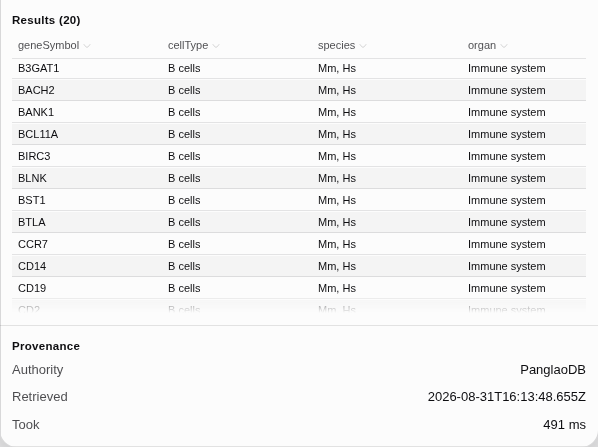 Twenty B-cell markers, answered from the table bundled with the app.
Everything past this point needs a network, and the panel tells you which sources have one before you press anything.
Worked example — asking a live authority
Open the Protein tools starter from the lobby. It opens on pEGFP-N1 (CVU55762), a real
4,733 bp cloning vector with four annotated features, including the EGFP CDS and a neomycin
phosphotransferase CDS.
- Open Tools → Analyze → Search Databases.
- Leave the source on Ensembl.
- Type
BRCA2and press Search.
Ensembl answers with the gene record — stable id, assembly coordinates, biotype, strand — and the Provenance section below the table lists the exact endpoints that were called, each one a link you can open yourself. That last part is the point of the panel: the answer is not ours, and you can always go and check it at the source.
Looking a variant up from the variant table
A VCF opened in the editor gets a Look up button on every row, and the point of it is that asking three different authorities about one variant is three different questions:
- gnomAD for how common the allele is in a population.
- ClinVar for whether anyone has called it pathogenic, and on what evidence.
- dbSNP for what the site is and what else has been reported there.
Two things about it are worth knowing before you trust an answer.
The reference build decides whether the question is even answerable. gnomAD's current release is
on GRCh38. Ask it for a GRCh37 coordinate and it does not complain — it answers successfully with no
variant, which reads exactly like "gnomAD has never seen this" and is not the same fact at all. So
when your file declares GRCh37 — most 1000 Genomes files do, as assembly=b37 — the menu offers
the liftover route instead and says why. Only a declared build is used; a file that does not say
which build it is on gets told so, rather than being guessed at.
A row with no rsID gets a weaker question, and the menu says which. With an rsID, ClinVar and dbSNP are direct lookups of that variant. Without one, all that can be asked is what has been submitted at this position — which may be a different allele than the one in your row. The difference is written on the menu entry rather than left for you to infer from the results.
The same applies to an interval: with a region filter set, Look up region asks Ensembl what is annotated there, UCSC for the sequence context, and gnomAD for the variation in it. gnomAD refuses any region wider than a million bases, and the menu says so before the request rather than returning an error afterwards.
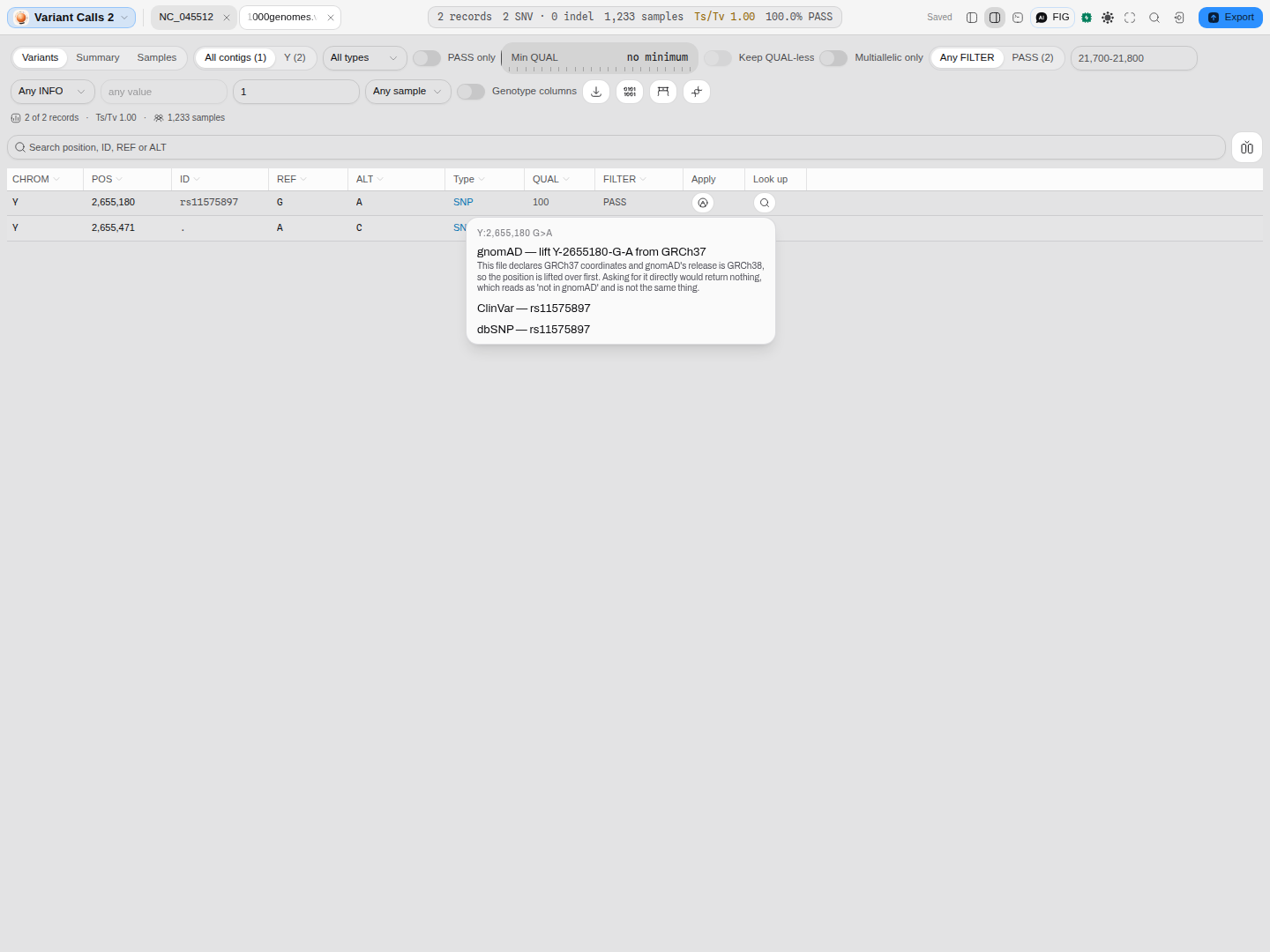 A real 1000 Genomes record. Because the file declares b37 and gnomAD is on GRCh38, the entry offers
to lift the coordinate over first — and says what would otherwise happen.
Reading the answer
Three sections sit under every run and each one exists because of a way this kind of tool usually misleads:
- Results shows every field the authority returned, not a chosen six. Click a row and the record opens in full.
- Incomplete appears when a source made several calls to assemble one record and some of them did not come back. ClinGen and NCBI Variation both work this way. Without this section a record built from two of six calls looks exactly like a complete one.
- Provenance carries the authority, the retrieval time, how long it took, and every endpoint called. This is what you paste into a methods section, and what you re-run in six months to see whether the answer has changed.
Limitations
- This panel reads; it does not compute. It will fetch a variant's allele frequency; it will not score your guide against a genome. Analyses live in their own tools.
- Fourteen of the sixty-two sources cannot be reached directly from a browser and are marked needs proxy. They are listed rather than hidden so you can see what exists, but without a deployment that proxies them they will refuse rather than answer. No source is marked unreachable altogether; the last one that was is described below.
- Reachability is a measurement with a date on it, and it decays. Every source carries the day its reachability was last checked, and the panel shows that date rather than a blanket one. BindingDB is the reason the date is shown at all: it was marked unreachable on the strength of one slow afternoon, and the panel refused the query before sending it for twenty-six days while the authority was answering in about a second.
- Rate limits apply and are the authority's, not ours. NCBI's E-utilities allow three requests a second to an anonymous caller. Rapid repeated queries will be throttled at the source. OpenAlex charges each search against a small daily budget that every anonymous caller on a network shares (it resets at midnight UTC); looking up a work, author or venue by its id costs nothing. An OpenAlex API key, entered under Your identity, gives searches their own budget.
- The GWAS Catalog holds published associations, not raw summary statistics. Every association in it has already passed a significance threshold. That is why the Manhattan plot drawn from it is a plot of hits, and why no QQ plot or genomic-inflation figure is offered: both compare an observed p-value distribution against the null, and a distribution consisting only of its significant tail would produce a confident, believable, meaningless number.
- On curated hits, the Manhattan's horizontal axis is coarse, and it says so. The layout places each chromosome after the span of the one before it, which is the standard convention and assumes a dense scan; a chromosome carrying a single published association spans a single base, so several such chromosomes land at effectively the same place. Their labels would print on top of each other, so the plot draws the ones that fit and reports how many it left unlabelled. Every point still names its own chromosome and position on hover, and the vertical axis — which is the axis that carries the evidence — is unaffected. Read the horizontal position as roughly where in the genome, never as a coordinate.
- Not every association has a mapped location. On a recent query for body height, 27 of the 100 strongest associations carried one; the rest are real records the Catalog holds without mapped coordinates, and the plot counts them rather than quietly plotting fewer points than you asked for.
- An eQTL query needs a locus, and this is a property of the data rather than a limitation of the panel. The eQTL Catalogue retired its search API; what it publishes instead is one enormous compressed table per dataset with a positional index beside it, so a question has to name a place on a chromosome. Asking for a gene alone cannot be answered — the panel says so and shows the query that can, rather than returning nothing. Pick a dataset first (there are 758, one per tissue and quantification method), then give it a region; the answer reads only the part of the file that overlaps that region, which is why a 4 kb window out of a three-gigabyte table returns in about a second and nothing is downloaded.
- An eQTL p-value that underflowed to zero cannot be plotted, and is named rather than moved. The published files carry a plain decimal column with no mantissa and exponent beside it, so a value that reached the bottom of double precision has genuinely lost its magnitude. Such rows are listed under the plot with that reason instead of being drawn at an invented ceiling.
- Licence terms are the authority's. The panel states them per source, with the date the page was read. KEGG and CADD in particular restrict use, and KEGG restricts offering it through a service separately from commercial use. What you may do with a record is between you and whoever published it.
Provenance and correctness
Every record carries its authority, the endpoint it came from and the time it was retrieved, so a result pasted into a notebook can be traced and refreshed. Nothing is cached behind your back.
The GWAS Catalog reader is checked against real recorded responses from the EBI, request by request,
across its whole route table — every search mode and every command, including a genuine
empty-result response and both not-found paths. That checking found two defects that a green test
suite had not: every variant lookup was returning a record with no coordinates, and a genuine
false was indistinguishable from "not stated".
gnomAD, ClinVar, dbSNP and NCBI Variation are now checked the same way, across their whole route tables — 50 recorded exchanges in total. Those recordings pin the things that are wrong in ways nobody notices: that a 1-based HGVS position becomes a 0-based SPDI one, that gnomAD's exome and genome frequencies stay separate rather than being averaged into a number that is neither, and that a mitochondrial variant is reported as heteroplasmy rather than borrowed diploid fields.
Fifty-eight of the sixty-two are now checked this way, over 219 recorded exchanges. What that
checking is for is the class of defect a passing test suite cannot see, and it keeps finding them:
that the effect size on every GWAS association was being dropped because the Catalog reports it as
0.0569 unit decrease and the reader wanted a number; that a UniProt record's sequence length was
read from a field UniProtKB does not have; that a compound lookup in BindingDB returned two real
affinity measurements and displayed none of them, because that route answers in a different dialect
from the one beside it.
The other four sources are not yet checked this way, and each has a reason rather than a backlog entry. One publishes no API to record (its data ships with the app instead). One requires a licence we have not taken. One has retired its API and answers "gone". One meters access by cost and refuses an anonymous caller.
Known to work and verified against recorded responses are different claims, and this page will not make the second one until it is true of a source.
The Manhattan plot's layout is verified against qqman, the R package that defines the convention,
over 17,669 plotted points across three datasets — every point, not a sample.
Related
In this group: Properties · BLAST Search · EMBL-EBI Services · Protein Domains · Protein Analysis · Protease Digest · Antibody Numbering · Mass spectrometry: peptide masses, b ladders, isotopes, spectrum scoring, q-values, protein inference · Codon Usage Analysis · Site avoidance: restriction sites a genome avoids or favors · Codon outliers: genes whose codon usage departs from their own genome · Tree incongruence: genes whose own alignment rejects the species tree · Reference stability: reference genes against genes of their own abundance · Annotation contradictions: UniProt features a predictor scores unlike confirmed ones · Hypothesis ledger: pre-register a hypothesis, attach runs, decide with e-BH · Reagent audit: does each annotated CDS code for what the map says, and are its cryptic promoters, splice sites and repeats worse than chance · Assay decay: does a published assay still match current genomes, and is the mismatch at the 3′ end · Gene incongruence: which loci of a multi-locus alignment have a different history · Target validation: test "gene G drives phenotype P" against gene-level evidence tables · Codon Tables · Enzyme Collections · Virtual Gel Bench · Phylogenetics · Dot Plot · Table · NumPy Array · Structure · PDF · Molecule · Image
Screenshots
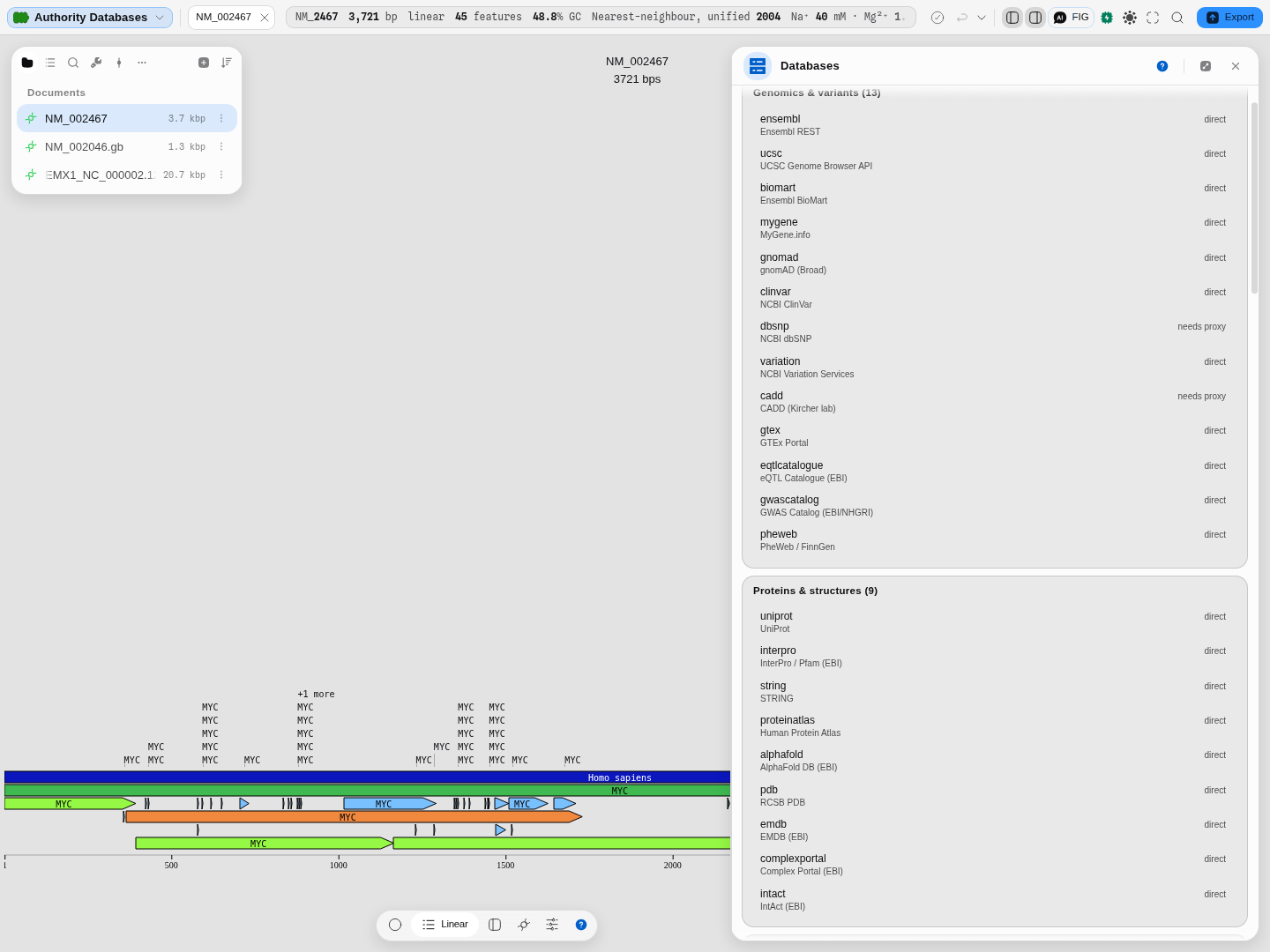 The panel as it opens: sixty-two authorities grouped by subject, each showing whether it can be
reached.
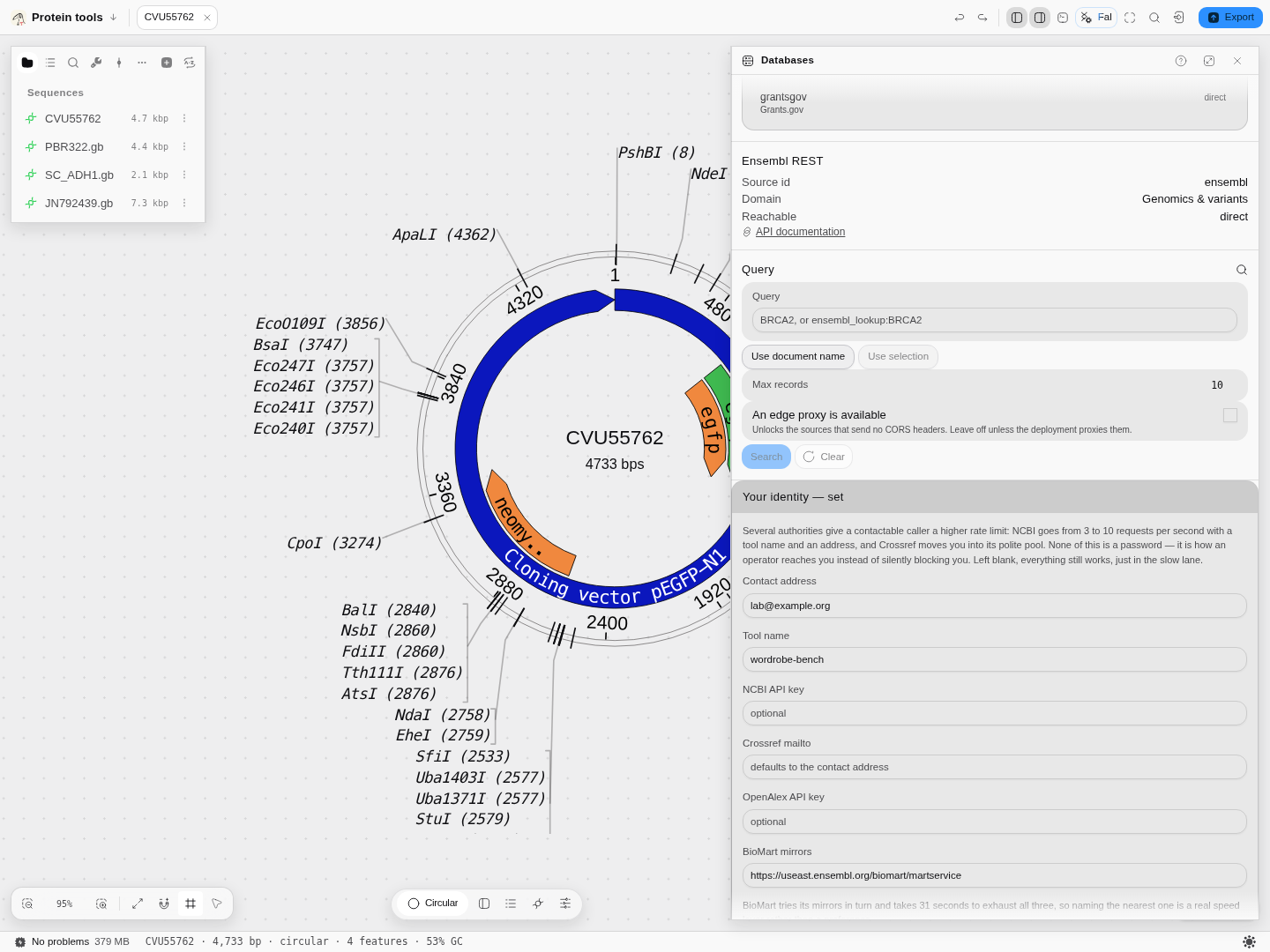 A contact address and a tool name, which is all it takes to move from three requests a second to
ten at NCBI. The heading says whether anything is set, because an unset identity produces no error —
only a slower answer.
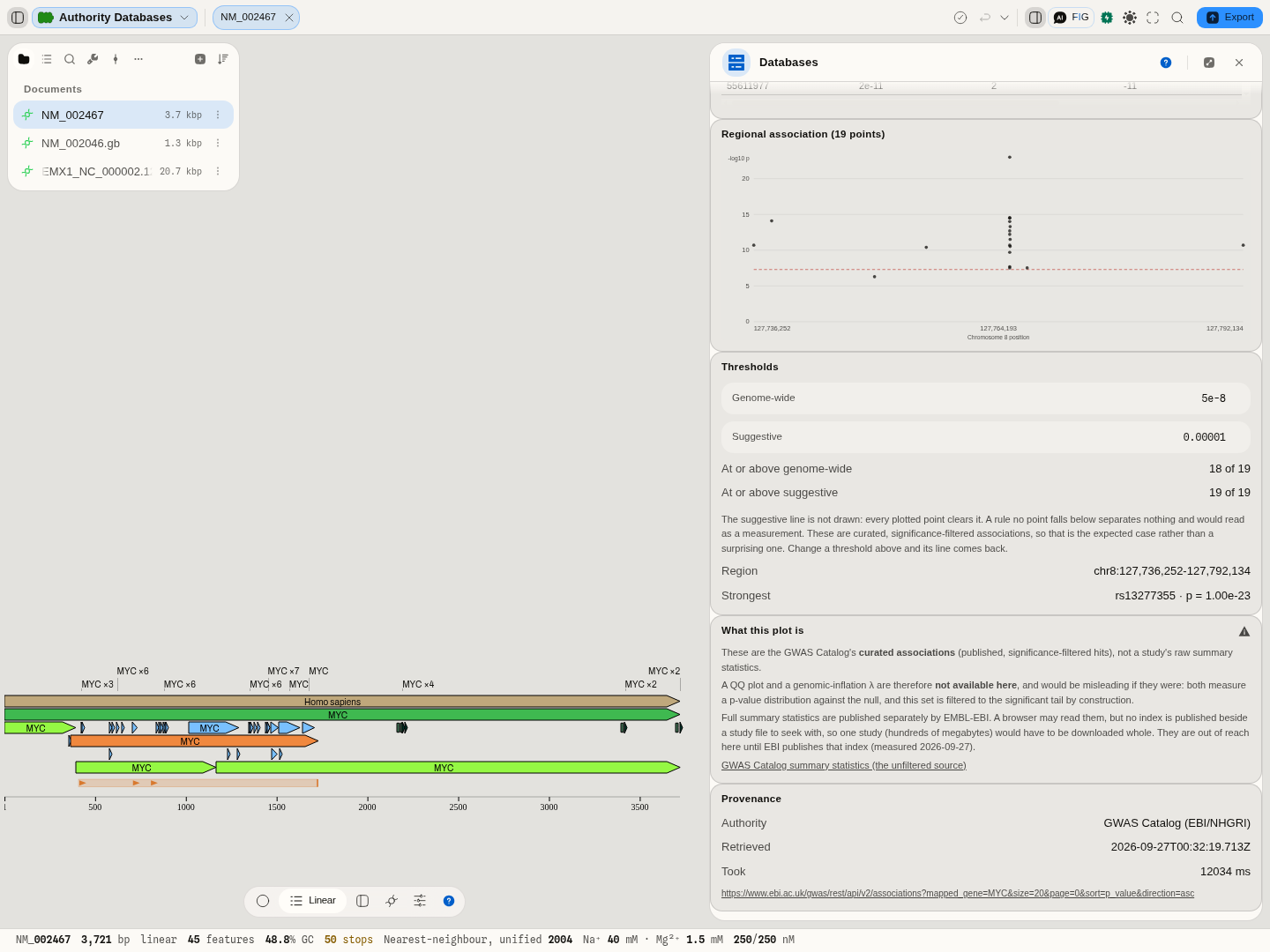 The GWAS Catalog's hundred strongest associations for body height, on a genomic axis. Everything
the plot could not do is stated beside it rather than left to be noticed: 73 records the Catalog
holds without a mapped location, and six chromosomes present but too sparse to label without
printing over one another. The strongest hit is named with its p-value in full.
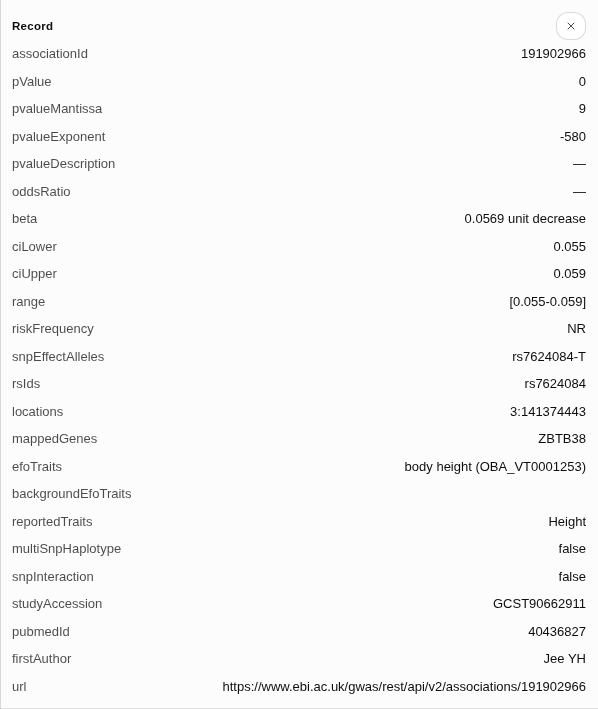 One record, opened from the plot. Every field the authority returned, not the six a table has room
for — including the effect size as the Catalog writes it,
0.0569 unit decrease, with the direction
word that decides what the number means.
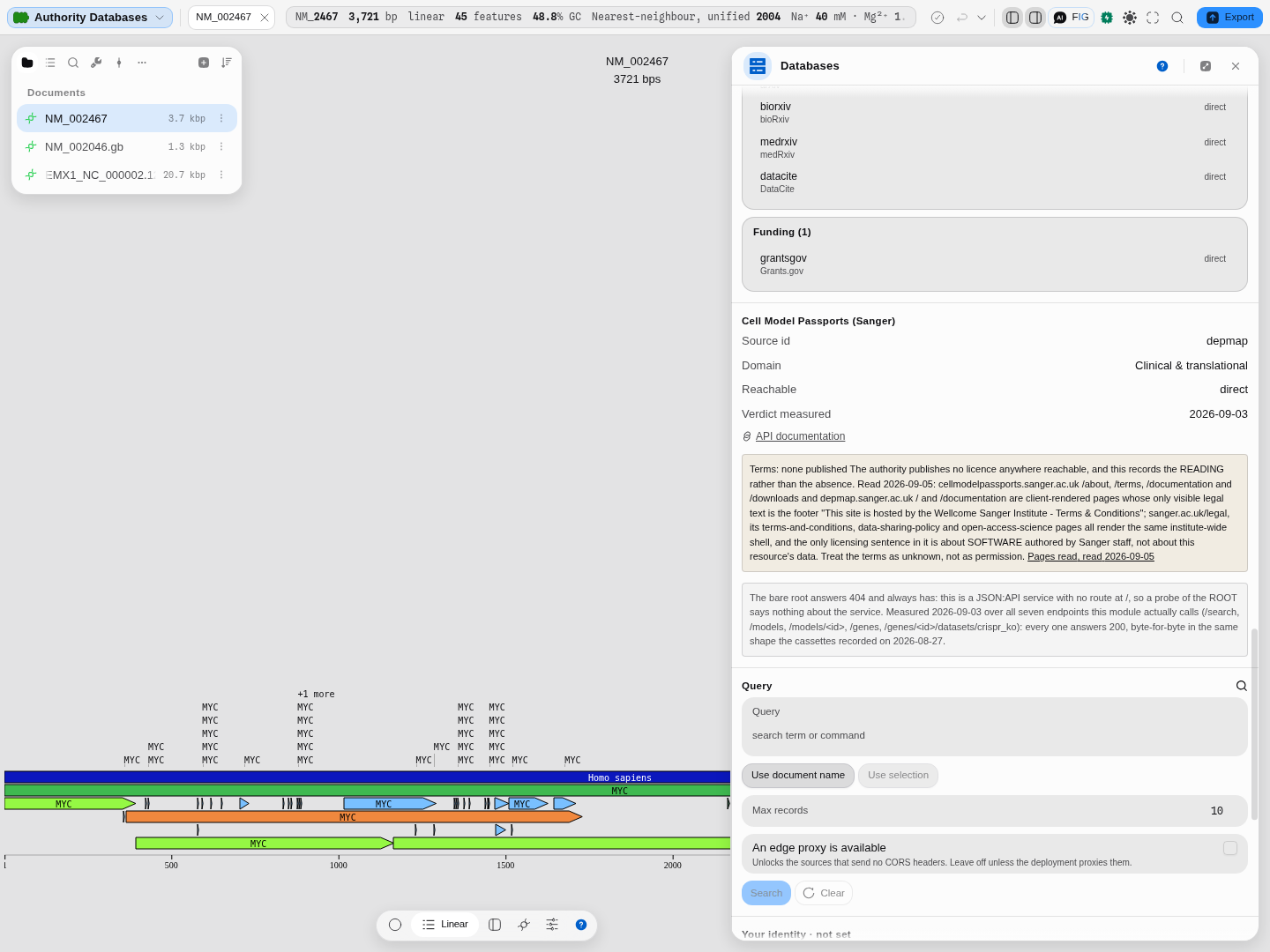 KEGG, selected. The amber Terms line carries the summary, the licence page and the date it was
read. A source nobody has read says "terms not checked" instead — a blank would read as permission.
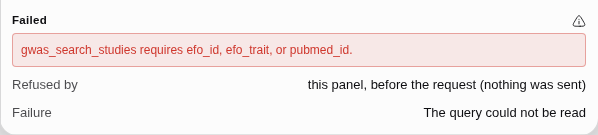 A query the panel would not send. The authority's requirement is quoted as the connector wrote it,
Refused by says the decision was made here with nothing sent, and the failure is named in words
rather than as the class name a program would use. Every refusal answers that middle question,
because it is the one that decides what you do next: fix the query, or wait for the database.
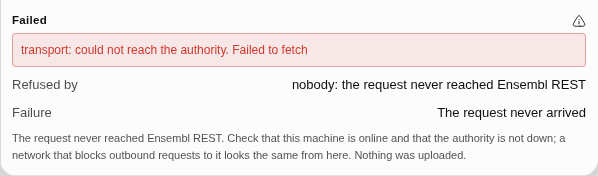 The same three lines when the request never arrives, and note the middle one: nobody refused it.
This is deliberately not "no results", and not "the authority said no" either. Confusing a database
that has no such record with one that never answered is how a real gene gets written off as missing;
blaming an authority that never saw the request is the same error pointed the other way. Captured on
a machine whose network blocks outbound requests to Ensembl.