
EMBL-EBI Services
Sixteen reference implementations — five multiple aligners, five pairwise aligners, three profile searches, a topology predictor, a repeat finder and a pattern discoverer — run on EMBL-EBI's servers and read back into the editor.
| Reached by | Tools → EMBL-EBI Services |
| Formats | FASTA in Aligned FASTA out CLUSTAL out Newick (.nwk) out EMBOSS report out |
| Sample project | BLAST & EMBL-EBI services |
What it does
It submits your sequences to EMBL-EBI's Job Dispatcher and brings the answer back into the editor: the alignment, the service's own percent-identity matrix, its guide tree, and — for the pairwise tools — the identity, similarity, gap and score figures the program itself printed.
The point is not that the workbench cannot align. It can: the local partial-order aligner in the Alignment tab runs offline and is the default. The point is that when you write a methods section you cite Clustal Omega or MAFFT by name, and a reviewer expects the numbers to be the ones those programs produce. This panel gives you the reference implementation itself, so the figure in your paper and the figure on your screen are the same figure.
Your sequences leave the machine when you press Run, and nothing before that. The panel says so above the button.
When you'd use this
- You have a barcode and a set of relatives. Align them with Clustal Omega, take the guide tree straight into Phylogenetics, and the tree you publish rests on the aligner your methods section names.
- You want a second opinion on a hard alignment. Run the same records through MAFFT and T-Coffee. Where three aligners place a gap in three different columns, that column is genuinely ambiguous and no single run would have told you.
- You are comparing exactly two sequences. needle for the whole of both, water for the best-matching stretch, stretcher when the pair is too long for needle to hold in memory.
- You suspect a repeat, or more than one conserved block. LALIGN, which is the only tool here that does not stop at the best match.
- Your protein has no obvious BLAST hit. phmmer searches with a profile rather than a sequence and finds remote homologues plain blastp misses; hmmscan asks the mirror-image question — which known families does this protein belong to.
- Your protein looks internally repetitive and nothing in a database says so. RADAR aligns the protein against itself, so it finds repeats that have no name and belong to no family — the copies, where each one starts and ends, and how much of the score survives without the profile the other copies build.
- You have a set of proteins and no motif to search for yet. Pratt reads the set and returns the patterns they share, written in PROSITE notation. Every other motif tool here needs the motif first; this is the one that produces it, and a pattern it gives you can go straight into a linear-motif search.
What this computes
Nothing locally: it submits to EMBL-EBI's Job Dispatcher and brings back what the reference implementation itself produced. Your sequences leave the machine when you press Run, and nothing before that; the panel says so above the button.
Why that is the point. The local partial-order aligner in the Alignment tab runs offline and is the default. But a methods section cites Clustal Omega or MAFFT by name, and a reviewer expects the numbers those programs produce — so this returns the programs' own output, and the figure on your screen is the figure in your paper.
Per multiple alignment: the aligned FASTA, the service's own percent-identity matrix, and its guide tree, where the program offers them.
Per repeat search (RADAR): every repeat family, and within it every copy with its residue span and two scores — the copy scored with, and without, the profile the other copies build, which is what separates a real repeat from a coincidence. Each family carries the level it was found at (level 1 is the longest; a higher level is a shorter repeat nested inside it), the diagonal and the band searched. A protein with no repeats is reported as none found, which is the answer for most proteins, not a failure.
Per pattern search (Pratt): the patterns the set shares, in PROSITE notation, ranked by fitness — information content, so a higher number is a more specific pattern rather than a more significant one. Each carries how many occurrences it has and in how many sequences, and where it matched in each one. Pratt's own pre-refinement list is deliberately not shown: those patterns are looser versions of the same ones and carry no positions.
Per pairwise run: the program's report verbatim — its identity, similarity, gap and score figures as it printed them. Save, Download and Copy all give you that exact text, never a re-rendering of it, because a re-typeset report is no longer the thing you would cite.
What it refuses, by name
- No contact email, no submission — EBI requires one, so the Run button stays disabled without it
- A span that does not fit the sequence on the canvas is refused with both lengths in the message, rather than selecting bases that are real but unrelated
- Protein-only services (the three profile searches and Phobius) say so before you submit rather than letting the job fail at EBI
- A report in a dialect no reader understands is reported as unreadable rather than shown as an empty alignment
- A residue position will not be dropped onto a nucleotide sequence. RADAR and Pratt count residues; putting one of their spans on the canvas checks that the sequence on screen really is the protein that was analysed (or the coding sequence for it, in which case it maps through the codons), and names both lengths when it is neither
- Cancel stops the watching, not the job. EBI publishes no way to withdraw a submitted job — it advertises the method and does not implement it — so pressing Cancel says exactly that: the run finishes on their cluster and stays claimable by its job id under Past runs. It counts against the fair-use budget either way, which is why it is worth knowing rather than being told "cancelled"
Where it lives
Tools → EMBL-EBI Services, in the right rail. Results are live editor context, not a dead readout: Select on map puts an alignment's span on the canvas as a real selection, in every view the molecule appears in, and the status bar reports it in the same coordinates the report printed. A finished multiple alignment offers Distance tree →, which seeds Phylogenetics with the gapped rows.
Inputs and outputs
In. For the multiple aligners, any set of records from the project — pick them in the panel's own file tree. For the pairwise tools, exactly two, chosen independently as Sequence A and Sequence B. Nucleotide or protein; the three profile searches and Phobius take protein only, and the panel says so rather than letting you submit and fail.
Out. Aligned FASTA for the multiple aligners, plus the service's percent-identity matrix and guide tree where it offers them. The pairwise tools return their own report verbatim, and Save, Download and Copy all give you that exact text — never a re-rendering of it.
What it refuses. A contact email is required by EBI on every submission and the Run button stays disabled without one. A span that does not fit the sequence currently on the canvas is refused by name, with both lengths in the message, rather than selecting bases that are real but unrelated. A report in a dialect no reader understands is reported as unreadable rather than shown as an empty alignment.
Worked example
Open the BLAST & EMBL-EBI services starter. It arrives with COI-crickets.fasta — eight cricket cytochrome oxidase I barcodes.
- Pick the tool. Service → LALIGN. The form under it is fetched from the service itself, so the matrix, gap penalties and expectation threshold you see are the ones LALIGN actually offers.
- Pick the two sequences. Tick
Phaneroptera_falcataandIsophya_altaica_EF540820, press Add to run, then set them as Sequence A and Sequence B. - Run it. Two alignments come back, not one.
- #1 — 82.4% identity in 601 nt, score 2051, 388.3 bits, E 4.7e-112, covering A 1–601 against B 1–601. This is the whole barcode against the whole barcode, and it is the only alignment water would have reported.
- #2 — 55.7% identity in 115 nt, score 92, 21.4 bits, E 0.12, covering A 54–168 against B 27–132. A second, offset, much weaker block. Its E-value of 0.12 says it is near the edge of chance — which is the honest reading, and exactly the judgement LALIGN exists to let you make.
- Put it on the map. Select on map on #2 selects 54–168 on the canvas: 115 bp, 27.0% GC. The status bar and the selection rail agree with the report.
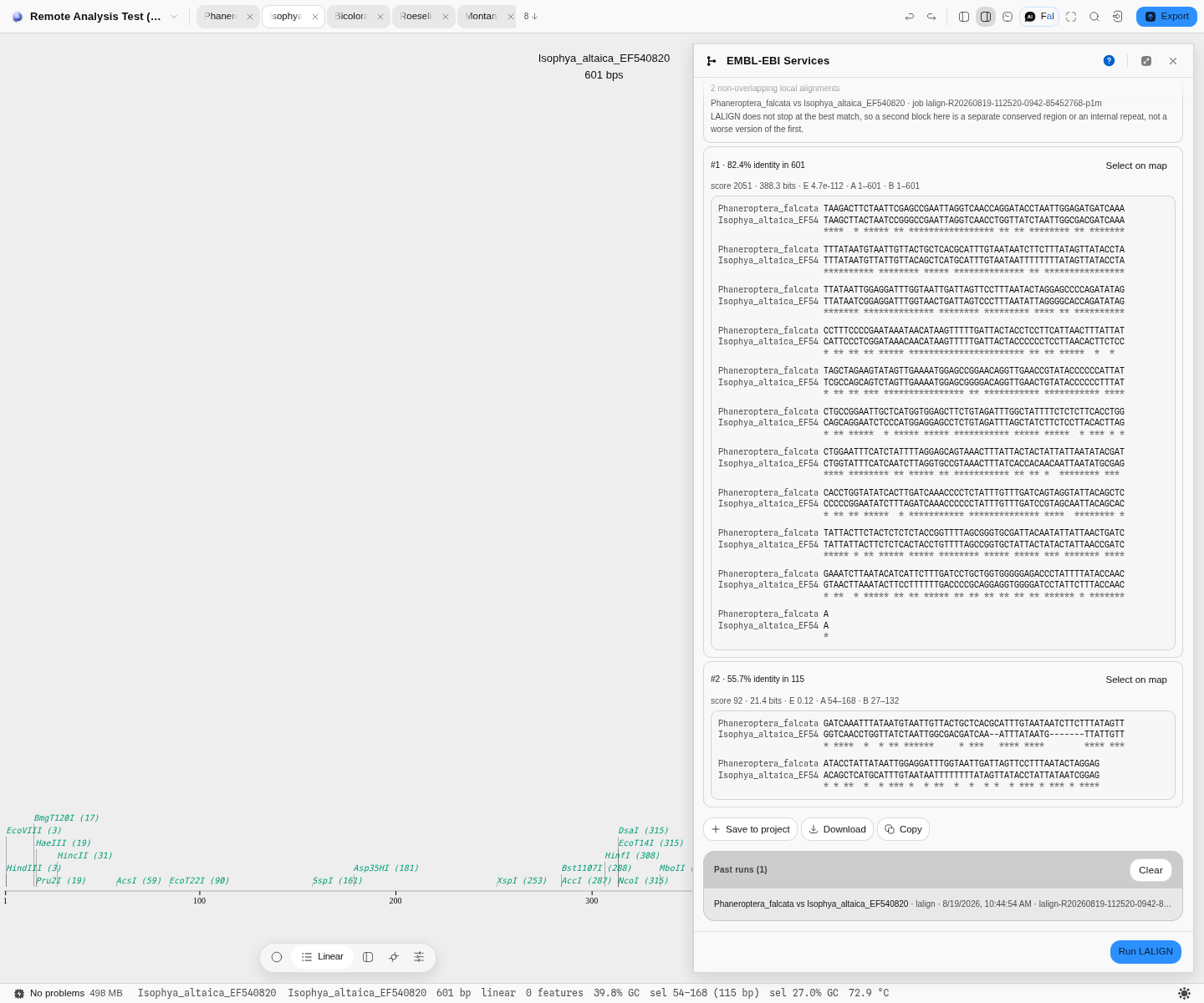 Both alignments the run reported, each with its own score, bits, E-value and spans. The status bar shows the second one's span selected on the sequence.
Controls
Every parameter each service advertises is discovered from the service when you pick it — nothing here is a fixed list that can go stale. For LALIGN that is the substitution matrix, the match/mismatch scores, gap open and extend, the expectation-value threshold and the output format; for Clustal Omega, its iteration and guide-tree options; for the EMBOSS pair, matrix and gap penalties. The contact email and the sequence type are ours, because EBI requires one and the other decides which services will accept the job at all.
By name: Service picks the program, Sequence to analyze the input, Sequence type the alphabet (DNA / RNA or Protein), and Name renames a sequence in a multiple alignment.
The alphabet decides which substitution matrices exist. A scoring matrix is a table of
substitution likelihoods for one kind of residue, so the protein matrices and the nucleotide ones are
different objects and not interchangeable settings: the EMBOSS pairwise programs publish 65
protein matrices — the BLOSUM series, derived from observed blocks of aligned protein, and the PAM
series, extrapolated from a point-mutation model — and two for nucleotides, DNAfull (the
IUB/IUPAC table, which scores ambiguity codes) and DNAmat. Setting the sequence type first is
therefore not a formality; it is what makes the matrix list mean anything, and choosing a protein
matrix for a DNA alignment is not a stricter setting but a meaningless one. Switch the sequence type
and a matrix that no longer applies is dropped rather than carried silently into the run.
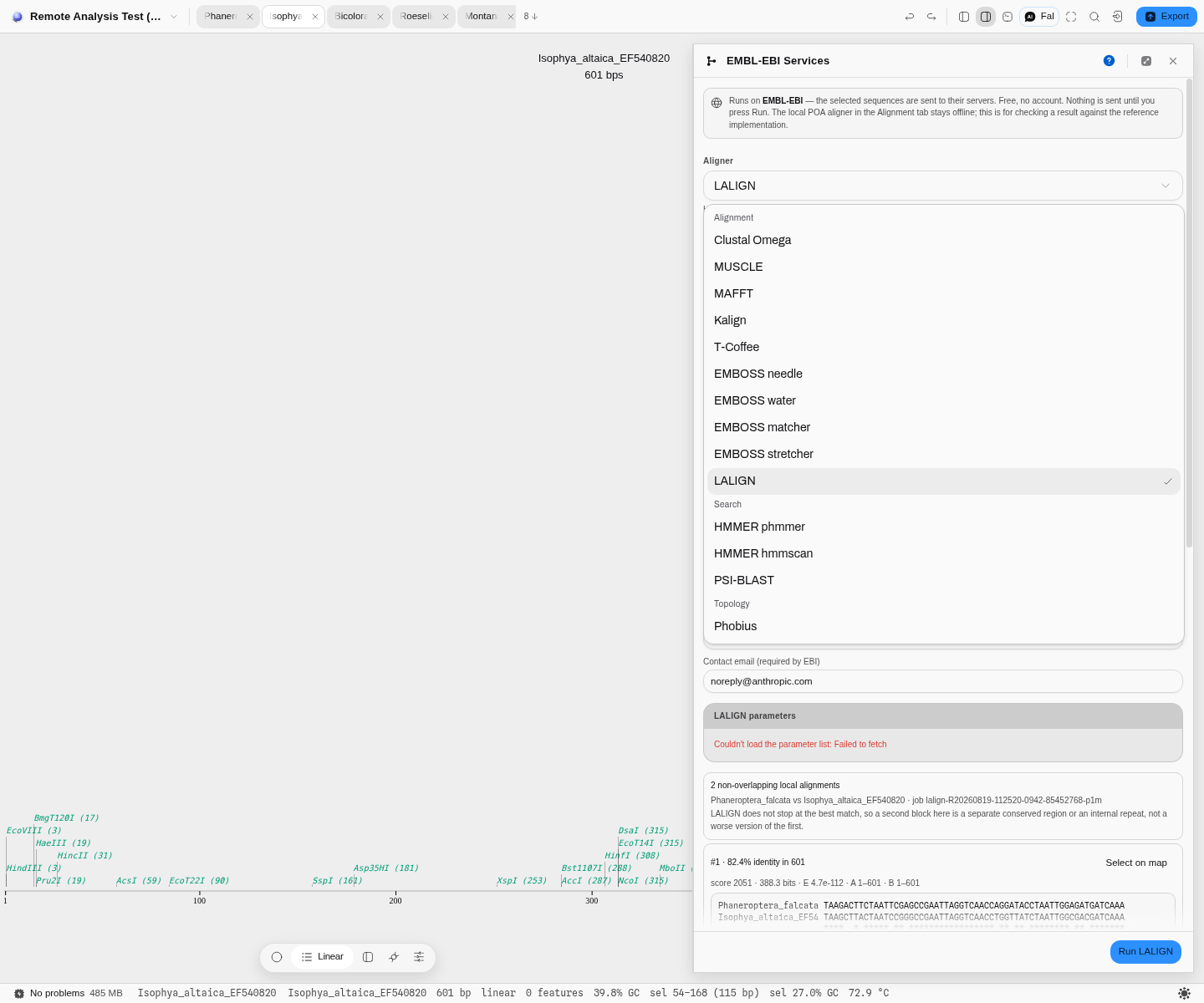 Alignment, Search and Topology. Each carries a one-line statement of the question it answers, so the choice is made on the science rather than on the name.
Algorithms you can choose
Multiple alignment — five, and they are not interchangeable.
| What it does | Reach for it when | |
|---|---|---|
| Clustal Omega (Sievers et al. 2011) | HMM-profile progressive alignment | The default, and the one most methods sections cite |
| MUSCLE (Edgar 2004) | Iterative refinement | A second, independent opinion on the same set |
| MAFFT (Katoh & Standley 2013) | FFT-based progressive, then iterative refinement | Large sets, and when you want the refinement itself tunable |
| Kalign (Lassmann & Sonnhammer 2005) | Wu–Manber approximate string matching | Speed, and when terminal gaps should score differently from internal ones |
| T-Coffee (Notredame et al. 2000) | Consistency-based | Hard cases: a column is placed by agreement across all pairs, not by one progressive pass |
Pairwise — five, and the difference is the question, not the quality.
| What it does | Reach for it when | |
|---|---|---|
| EMBOSS needle | Needleman–Wunsch, global | You want the whole of both sequences aligned end to end |
| EMBOSS water | Smith–Waterman, local | You want the single best-matching subregion |
| EMBOSS matcher | Waterman–Eggert, local | You want water's answer plus the next best alternatives — up to five, and you choose how many |
| EMBOSS stretcher | Myers–Miller, global, linear space | The pair is too long for needle to hold in memory |
| LALIGN (Huang & Miller 1991) | Non-overlapping local alignments | You expect more than one conserved block, or an internal repeat |
Profile search and topology. phmmer (sequence against a database), hmmscan (sequence against Pfam), PSI-BLAST (iterated profile search, with the round history kept so you can see what each iteration added), and Phobius, which models signal peptide and transmembrane topology together so a signal peptide is not miscalled as a TM helix.
A note worth having: on a clean, gap-free set the aligners agree. Aligned against each other on the four cricket barcodes, Clustal Omega, MUSCLE, MAFFT, Kalign and T-Coffee place every column identically. That is a property of easy data, not evidence that the choice does not matter — the disagreements appear exactly where the alignment is hard, which is where you needed the second opinion.
The science
Every service here is the real program, run by EMBL-EBI on their hardware. There is no local re-implementation standing in for any of them, and no result on this panel is computed by us.
What we do own is the reading of what comes back, and one distinction is worth knowing because it is invisible: needle and water print their alignment in EMBOSS's srspair layout, with position numbers on both sides of every sequence row, while matcher, stretcher and LALIGN print markx0, which carries no position numbers at all and puts the coordinates on separate ruler lines. The statistics header is byte-identical between the two. A reader written for one and pointed at the other therefore reports perfectly correct identity and score above a blank alignment. Both layouts are read here, the one used is recorded, and a dialect neither reader recognises is reported as unreadable rather than shown as empty.
Asking matcher for more than one answer
Water gives you the single best local alignment. Matcher gives you that one and the next best non-overlapping ones, and how many is yours to choose: its Additional alignments control takes 1 to 5, and the service's own default is 1 — so out of the box matcher answers exactly like water, and the reason to reach for it is that you can raise that number.
Raise it when you have a reason to think one alignment is not the whole story: an internal repeat, a duplicated domain, a shared motif in otherwise unrelated sequences, or a pair that aligns well at one end and suspiciously badly at the other. The alignments come back best-score-first, each with its own identity, gap count, score and span, and each is shown as its own block — because they are separate findings, not one finding rendered in pieces.
Read the weaker ones sceptically, and read them by their statistics rather than by their presence. On the two cricket barcodes, asking for three gives:
- 495/601 identities (82.4%), score 2051 — the real alignment, the whole barcode.
- 64/115 (55.7%), score 92 — a short offset block. At 55.7% over 115 nt of DNA this is close to what two unrelated sequences of that length would give you by chance.
- 32/51 (62.7%), score 84 — shorter still, and the same caution applies more strongly.
That is the useful shape of the answer: one strong alignment and a tail that falls away fast tells you there is one relationship here, not three. A second alignment with a score in the same league as the first is the interesting case, and it is the one you would never see with the control left at 1.
Matcher's scores are Waterman–Eggert, which is what makes the alternatives non-overlapping: each alignment is found after the previous one's cells have been removed from the matrix, so the second result cannot simply be the first one shifted by a base. LALIGN answers the same question with an E-value attached, which is easier to judge — reach for matcher when you want EMBOSS's scoring and parameters, and for LALIGN when you want the significance stated for you.
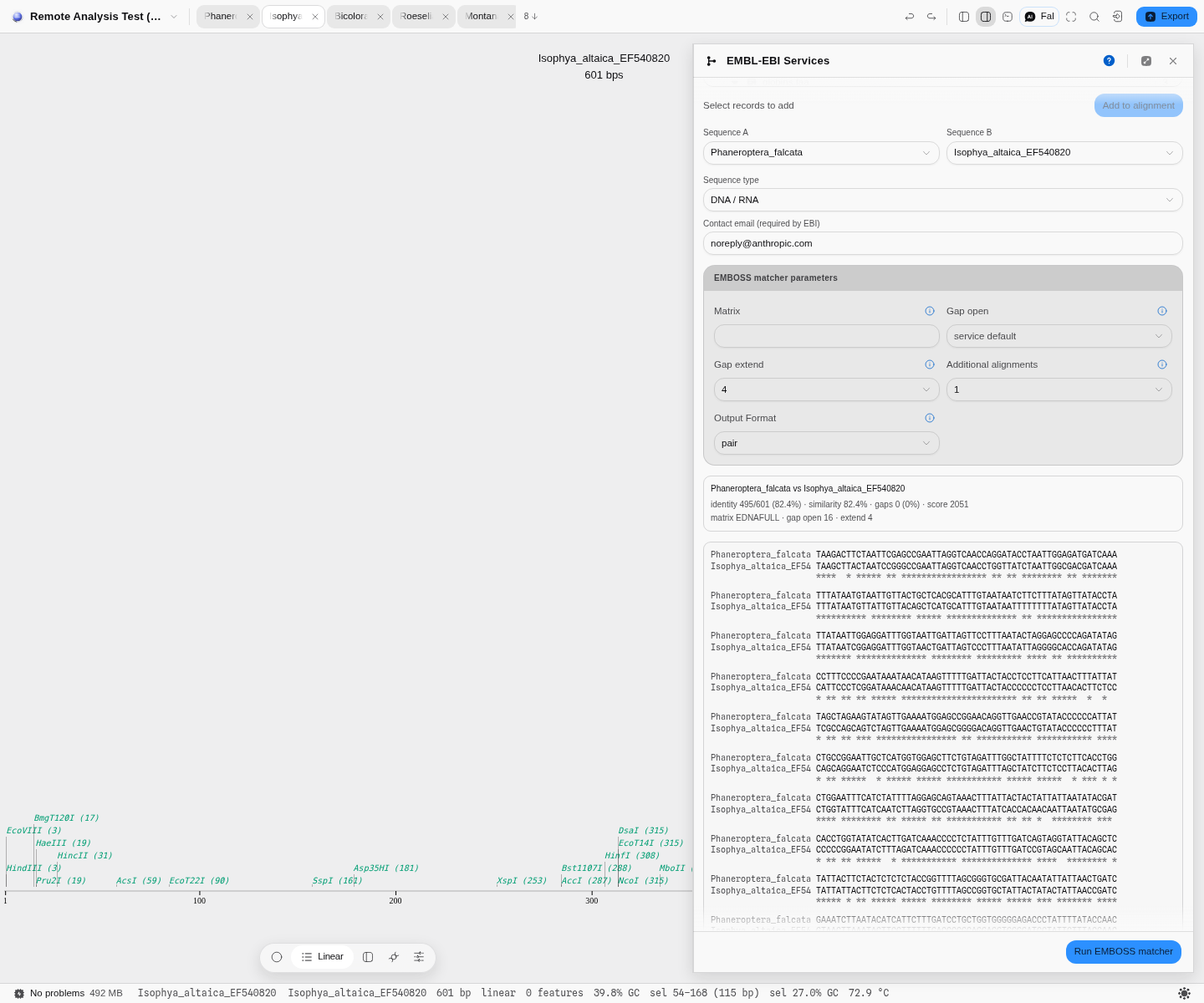 Waterman–Eggert local alignment of two cricket barcodes: 495/601 identities (82.4%), score 2051, EDNAFULL, gap open 16 / extend 4 — with the alignment itself underneath, which is the half a reader written for the other layout silently loses.
Shared with other tools: Alignment scoring compares how every tool that does this chooses its method.
Limitations
- A run is a network call. Jobs take seconds to minutes depending on the service and the load, and a whole-database search can take considerably longer. EBI asks for batches of thirty at a time, waited on rather than fired in parallel.
- Your sequences leave the machine. Unavoidable for a remote service, stated on the panel, and never automatic.
- The pairwise coordinate spaces are separate. An alignment's span belongs to the sequence you submitted as A. It is not necessarily the sequence on your canvas, which is why selecting it is guarded rather than assumed.
- The guide tree is not a phylogeny. It is a clustering artefact computed before the alignment exists. The Distance tree hand-off, computed from the aligned rows, is the one to publish; the two look identical on screen and are not the same claim.
Export
Save to project (the result becomes a real file the next tool can open), Download, and Copy. For any report-shaped service the bytes are the service's own report, unchanged; for a multiple alignment, aligned FASTA. A finished alignment also hands off directly to Phylogenetics.
Provenance
Every run records its EBI job id, and the panel keeps a history of past runs with the id, the service and the time. The job id is the thing to quote: it is EBI's own handle on the run, and it is what makes the result reproducible by someone who is not you.
Correctness of the readers is checked against real service output rather than against handwritten examples — the reports the parsers are tested on are the exact bytes real jobs returned, including the two-alignment LALIGN run described above.
Screenshots
LALIGN reports every non-overlapping local alignment, each with its own statistics.
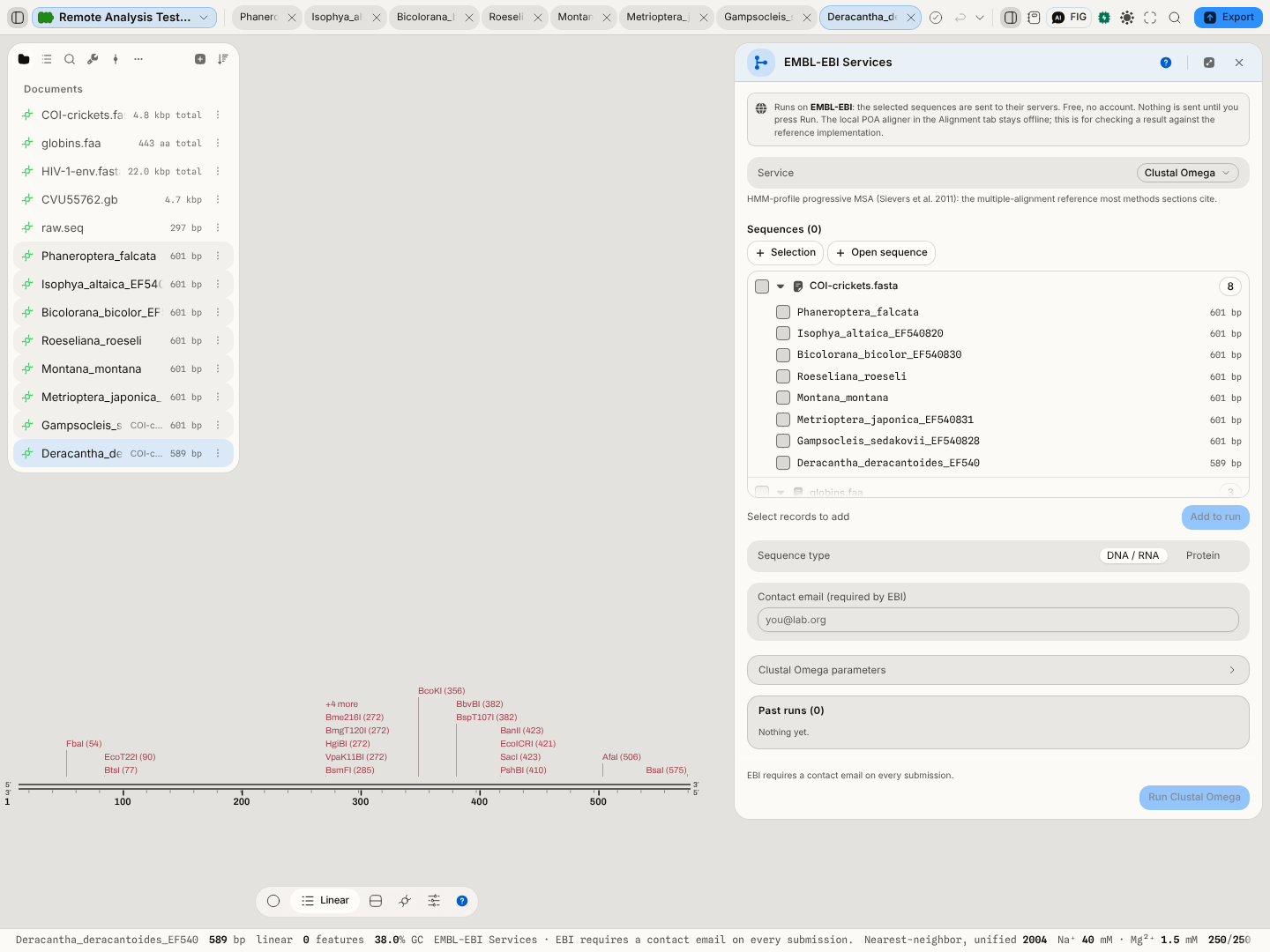 The panel as it opens.
Related
Feeds it: the project's own sequences, or a selection on the canvas. Follows it: Phylogenetics via the guide tree or the distance tree, and the canvas itself via Select on map. An alternative to: the offline aligner in the Alignment tab, which is the default and needs no network.
In this group: Properties · BLAST Search · Search Databases · Protein Domains · Protein Analysis · Protease Digest · Antibody Numbering · Mass spectrometry: peptide masses, b ladders, isotopes, spectrum scoring, q-values, protein inference · Codon Usage Analysis · Site avoidance: restriction sites a genome avoids or favors · Codon outliers: genes whose codon usage departs from their own genome · Tree incongruence: genes whose own alignment rejects the species tree · Reference stability: reference genes against genes of their own abundance · Annotation contradictions: UniProt features a predictor scores unlike confirmed ones · Hypothesis ledger: pre-register a hypothesis, attach runs, decide with e-BH · Reagent audit: does each annotated CDS code for what the map says, and are its cryptic promoters, splice sites and repeats worse than chance · Assay decay: does a published assay still match current genomes, and is the mismatch at the 3′ end · Gene incongruence: which loci of a multi-locus alignment have a different history · Target validation: test "gene G drives phenotype P" against gene-level evidence tables · Codon Tables · Enzyme Collections · Virtual Gel Bench · Phylogenetics · Dot Plot · Table · NumPy Array · Structure · PDF · Molecule · Image